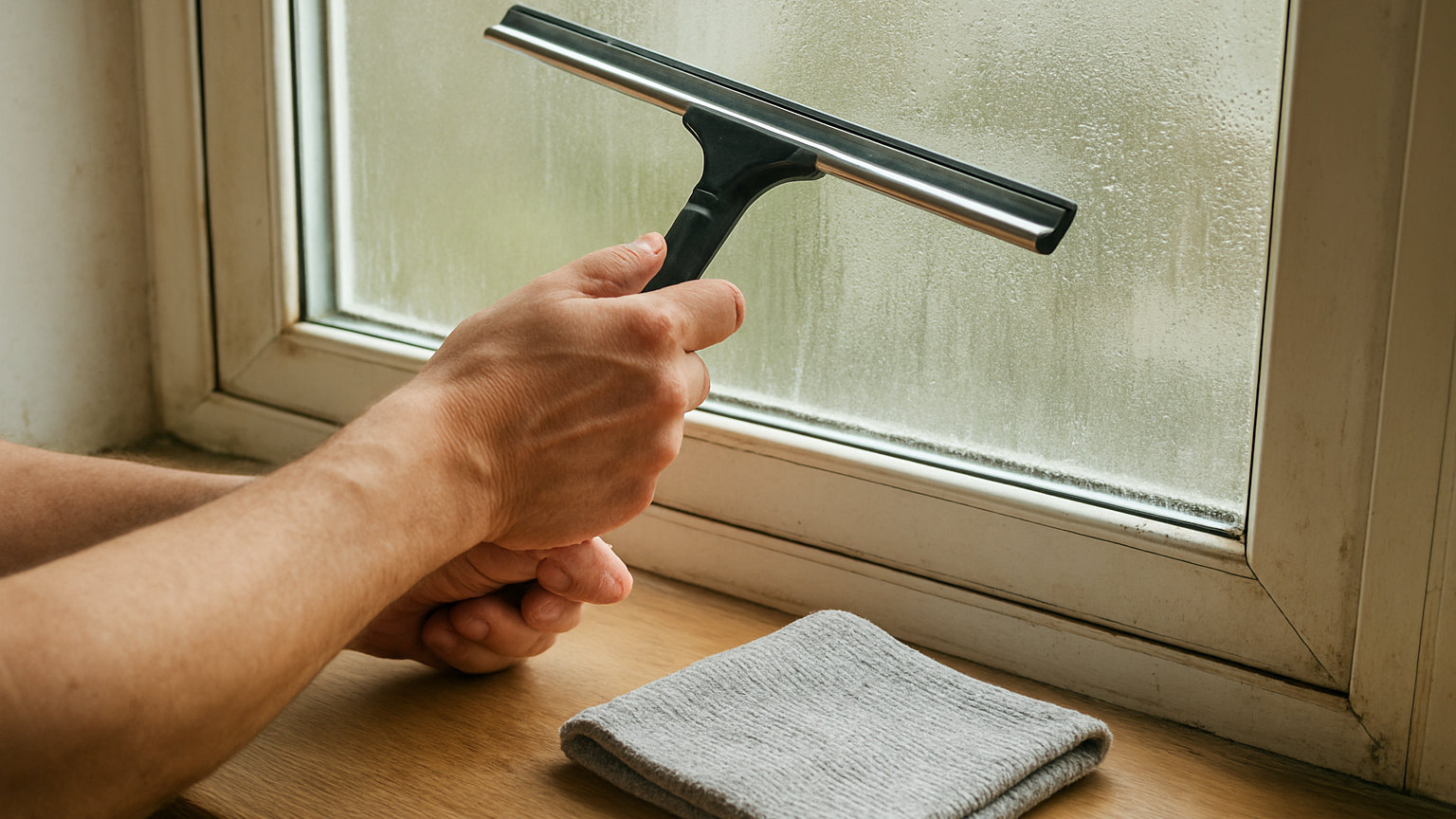
A squeegee is the difference between glass that looks clean and glass that looks professionally cleaned, and the technique is easy to learn. The principle is simple: every stroke must overlap the last, and the blade must never lift off a wet area and put down on a dry one without a clean edge to work from.
What angle should the blade be at?
Roughly 30 to 45 degrees to the glass, tilted so that the top edge of the blade leads. Held flat against the glass it skips and chatters; held too steeply it leaves a film of water behind. A light, even pressure is all that is needed. Pressing hard bends the rubber out of shape and produces a line rather than a clean edge.
What is the straight pull method?
The easiest technique for a beginner, and perfectly good for domestic windows.
- Wet and scrub the glass with the applicator, covering every part including the corners.
- Dry the squeegee blade on a cloth.
- Start at the top left, and draw the squeegee straight down to the bottom in one continuous stroke.
- Wipe the blade dry.
- Start the next stroke overlapping the first by two or three centimetres, so the blade begins on already dry glass and works into the wet.
- Repeat across the window, wiping the blade every stroke.
- Wipe the bottom edge and the sides with a dry microfibre cloth.
Drying the blade between strokes matters more than people expect. A wet blade redeposits water at the start of the next pull.
What is fanning, and is it worth learning?
Fanning is the continuous S shaped motion professionals use, where the squeegee never leaves the glass and the whole window is done in one movement. It is faster and leaves fewer edges to detail, and it takes practice to do well.
It is worth learning if you have a lot of glass – a conservatory, patio doors, a large bay – and unnecessary for a few ordinary windows, where the straight pull is almost as good and much easier to get right first time.
Why is there a line at the edge of every stroke?
Usually because the strokes are not overlapping enough, or because the blade is not being dried. Sometimes because the blade itself is damaged. Run a fingertip along the rubber: any nick, flat spot or hardened section will leave a line on every stroke, and replacing the blade fixes it instantly.
Blades are consumable. A blade used weekly might last a few months, and one left resting on its edge in a cupboard can be ruined without ever being used.
How do you handle the edges and corners?
The squeegee cannot reach right into a corner, so there will always be a little water at the perimeter. Wipe it away with a dry microfibre cloth wrapped over a finger, working around the whole frame. Do this immediately, before it dries and leaves a mark.
For the bottom edge, run the cloth along the glass just above the frame, not into the frame, or you will pull dirt back onto the clean glass.
Does the size of the squeegee matter?
It should be narrower than the pane, so the blade stays in contact with the glass throughout. A 25 to 35cm blade suits most domestic windows. A wider one is faster on large panes but useless on small georgian bars, where a narrow blade or a cloth is the only option.
Can you use it on other surfaces?
Yes, and it is worth doing. A squeegee run over a shower screen after every use is the single most effective way to prevent limescale forming, and it takes about fifteen seconds. The same tool works on wall tiles, on a bathroom mirror, on a glass splashback behind a hob and on a conservatory roof reached with a pole from below. The overlapping stroke technique applies to all of them, which makes learning it once unusually good value.