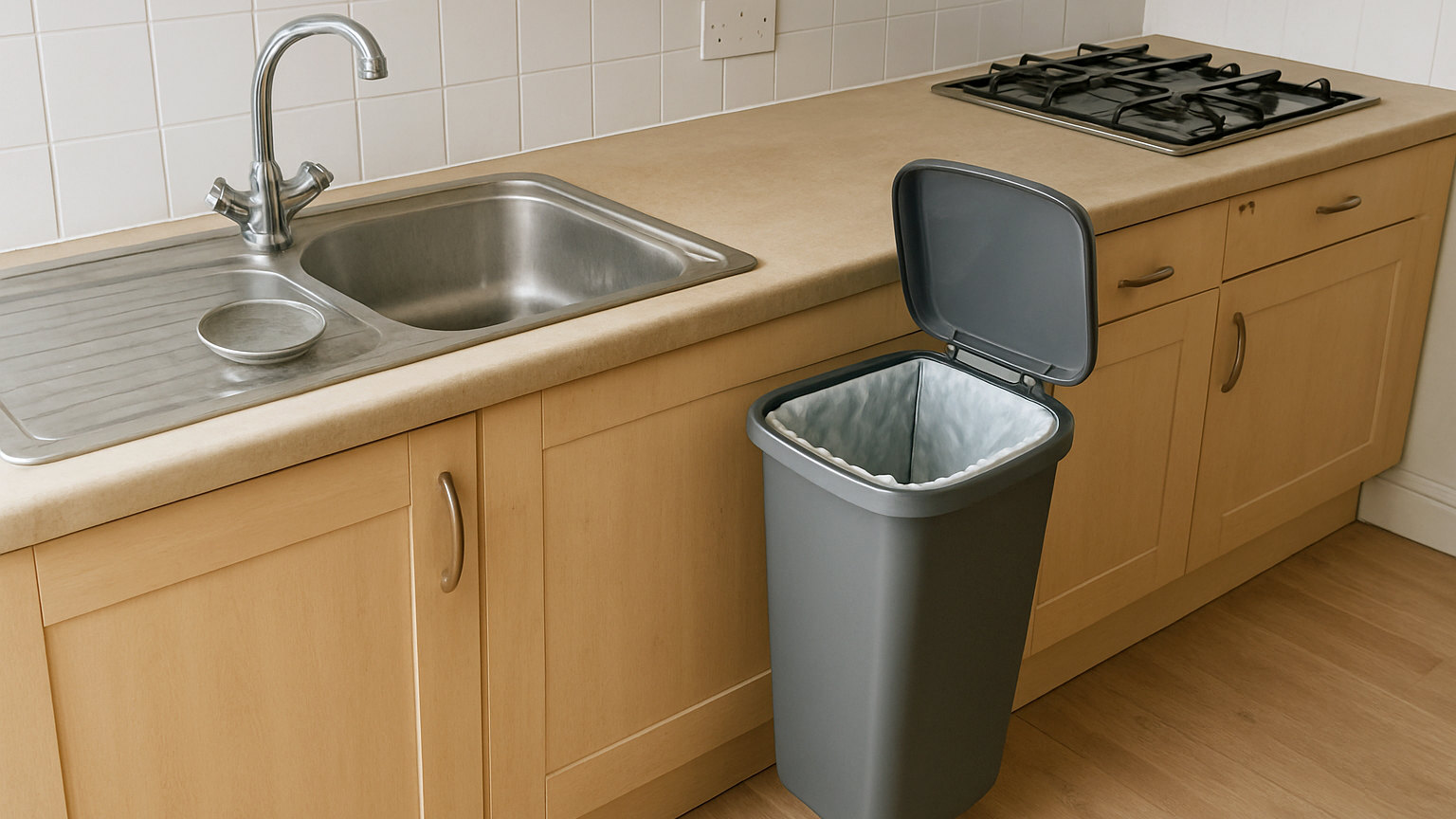
A kitchen bin that still smells after the bag has gone out has residue somewhere other than the bag, and there are only a few places it can be. Once you know where to look, stopping the smell is a ten minute job rather than a running battle with air freshener.
Where does the smell actually come from?
Bacteria breaking down food waste release gases, and they need moisture to work. The bag holds most of the waste, but liquid escapes constantly: condensation from warm leftovers, juice from packaging, and whatever leaks through a small tear. That liquid collects in four places.
- The base of the bin, under the liner. The most common culprit, and invisible until the bag comes out.
- The lid, and particularly the mechanism. Warm damp air rises, condenses on the underside of the lid and dries into a sticky film. Pedal bins and touch-open bins have hinges and springs that trap it.
- The rim, where the liner folds over. Wiped by the bag every time waste is pushed down.
- The gap between an inner caddy and the outer casing on double or recycling bins.
How do you wash a bin properly?
Take it outside or into a shower tray if the weather is against you. Rinse it out with hot water, then wash the inside, the outside, the rim and the whole lid with hot water and washing up liquid, using a long-handled brush. Pay particular attention to the lid mechanism and the underside of the lid, and get into the hinge with an old toothbrush.
Rinse thoroughly, then disinfect if you want to, and here the order matters: disinfectant applied to a dirty surface does very little, because organic matter deactivates it. Clean first, disinfect second, and leave the product on the surface for the contact time on the label rather than wiping it straight off.
Then dry it completely, ideally upside down in the fresh air. A bin put back damp will smell again within a couple of days.
What if the plastic still smells after washing?
Odour compounds soak into plastic that has been wet for a long time, especially where it is scratched. Two things help. Sunlight is genuinely effective, so leave the bin outside on a bright day with the lid open for a few hours. Failing that, put a couple of tablespoons of bicarbonate of soda in the dry bin, leave it overnight, and tip it out.
If neither works, the bin has usually reached the end of its life. Deep scratches in the base hold residue that cannot be reached.
What stops it coming back?
Keeping the inside dry is most of it. Practical measures, in rough order of how much difference they make:
- Separate food waste into a small caddy with a compostable liner and empty it every day or two. It is the single biggest change.
- Drain and wrap wet waste before it goes in. Meat packaging and fish trimmings do best going straight into an outside bin.
- Put a folded sheet of newspaper or kitchen paper in the base under the liner to absorb leaks.
- Use liners that actually fit. An oversized bag sags and pulls away from the rim, letting waste fall behind it.
- Sprinkle bicarbonate of soda in the base when you change the bag.
- Empty the bin before you go away, even if it is only half full.
Does the position of the bin make a difference?
Yes. A bin in a warm spot – next to a radiator, in direct sun through a window, or in a cupboard beside the oven – will smell far sooner than the same bin somewhere cool, because bacterial activity roughly doubles with every ten degree rise in temperature. A cupboard bin also has no air movement at all, so any smell concentrates.
How often should a bin be washed?
Once a month for a bin with a separate food caddy, and every week or two for one taking all the food waste. Wipe the lid and rim every time the bag is changed, which takes seconds, and the monthly wash stops being a grim job.
Masking the smell with a scented product does nothing about the bacteria producing it, and a heavily perfumed bin usually smells worse than an unscented one, because the two smells sit on top of each other rather than cancelling out.