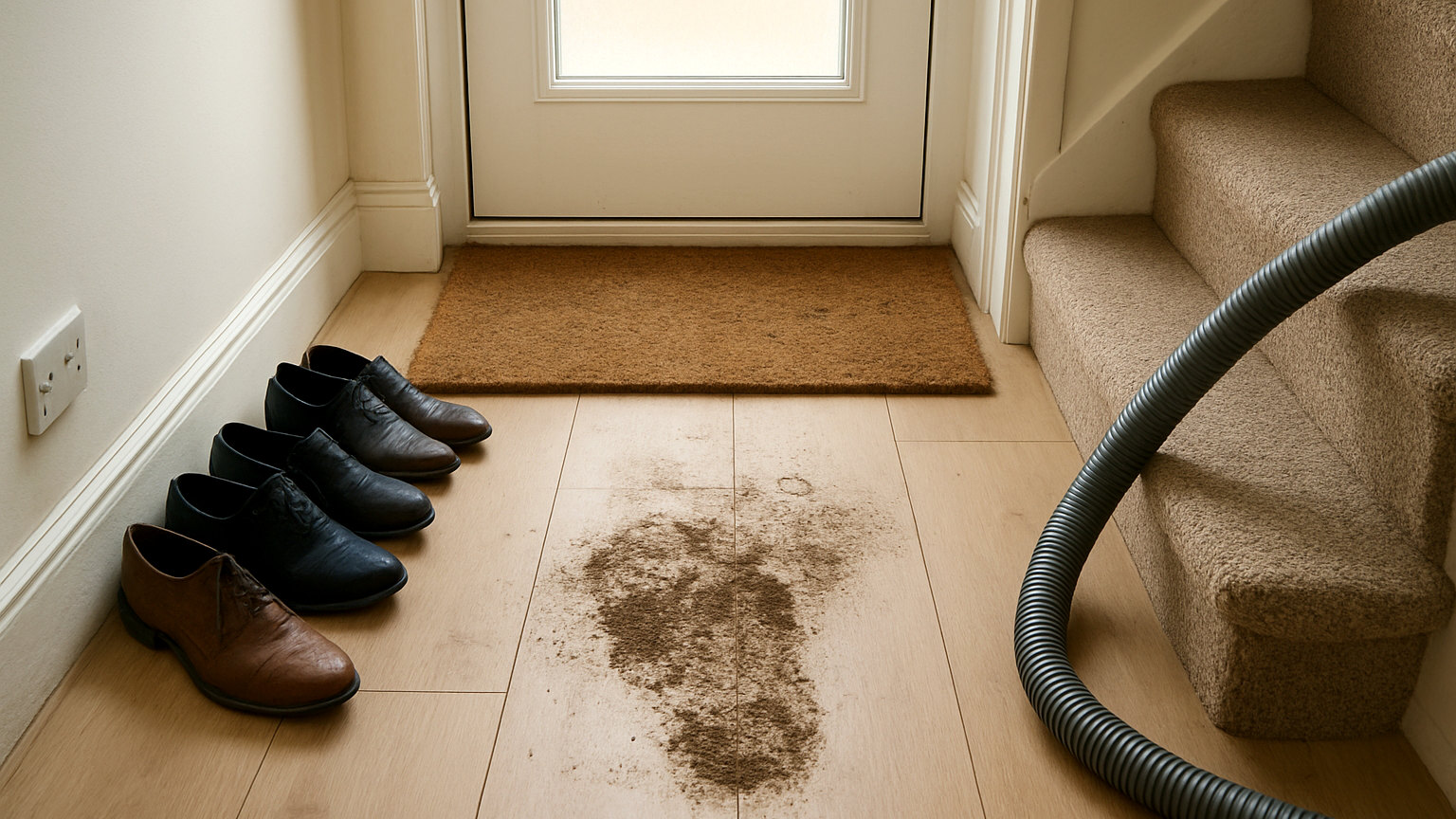
Mud and road salt are the two things a hall carpet takes most of between October and March, and they need opposite approaches. Mud should be left alone until it is completely dry. Salt needs treating while the marks are fresh, and it needs an acid rather than a detergent to come out properly.
Why should you let mud dry?
Because wet mud is a liquid that spreads. Attacking it with a cloth pushes fine particles deep into the pile and down into the backing, turning a surface deposit into an embedded stain covering three times the area. Dry mud, by contrast, is a solid that breaks up and can largely be vacuumed away.
Leave it for a few hours, or overnight, resisting the urge to do something immediately. Put a chair over it if there is any risk of someone walking through.
What is the method for dried mud?
- Break the crust up gently with a blunt edge such as a spoon handle or a soft brush, working from the outside inwards.
- Vacuum thoroughly, going over the area several times from different directions.
- Repeat the brushing and vacuuming until nothing further lifts.
- Treat any remaining discolouration with a solution of warm water and a small amount of washing up liquid, applied to a cloth rather than poured on.
- Blot from the outside in, rinse by blotting with a cloth dampened in clean water, then press a dry towel under weight to draw the moisture out.
Dry the area quickly with a fan or an open window. A damp patch in a hall carpet is walked on within minutes, which re-soils it immediately.
Why is road salt different?
Because it is a dissolved mineral rather than a particle. As the water carrying it evaporates, the salt crystallises in the carpet fibres and leaves the characteristic white tide mark, often in the outline of a shoe. Detergent does very little to it, and vacuuming alone will not lift crystals that have formed around the fibres.
Salt is also mildly corrosive and hygroscopic, meaning it draws moisture from the air, so a carpet with salt in it stays damp and attracts more dirt.
What removes salt marks?
A mild acid. Mix one part white vinegar to two or three parts warm water, apply it to a cloth, and dab the marked area. The acid dissolves the crystalline deposit so it can be blotted out. Follow with a clean water blot to remove the vinegar, then press dry with a towel.
Test on a hidden corner first, and do not use vinegar on wool carpet without checking, since strong acid concentrations can affect the dye. Dilute is the important word.
Do the marks come back?
Sometimes, a day or two later, which is the sign that salt remains deeper in the pile or in the backing. This is wicking: residue moves back up the fibres as the carpet dries. The remedy is a second treatment and a more thorough extraction of moisture afterwards, pressing a dry towel down under weight for several hours rather than blotting briefly.
What prevents most of it?
Barrier matting and a boot tray by the door, so the salt never reaches the carpet in the first place. In salting season, vacuuming the entrance daily rather than weekly makes a substantial difference, since salt crystals sitting on the surface are easy to remove and salt that has been walked in and dampened is not.
Wiping shoes and paws before they come past the mat is worth more than any product.
When is it worth calling a professional?
For a large area, for an old carpet where wicking keeps returning, or for wool and natural fibre carpets where the risk of doing damage is higher. Hot water extraction with proper suction removes both the deposit and the water carrying it, which is the part that is difficult to replicate with cloths and a bowl.