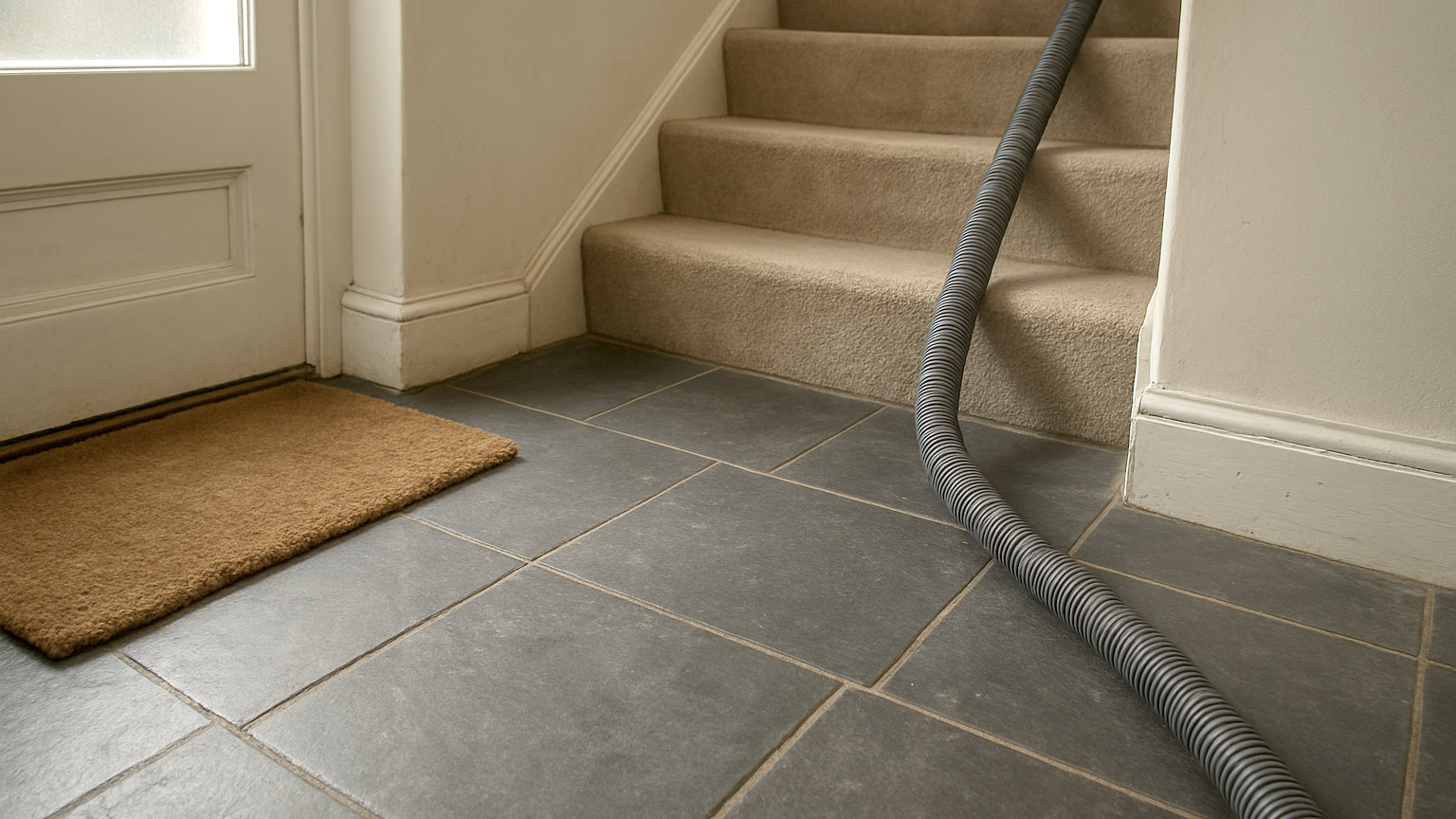
Stair carpet has a harder life than any other floor covering in a house. Every step lands on the same narrow strip at the front of each tread, grit gets driven into the pile at an angle, and the corners where the tread meets the riser collect everything a vacuum head cannot reach. Cleaning stairs properly means treating those two zones differently from the rest.
Where does the dirt actually sit?
In three places. The nosing, which is the rounded front edge of each tread and takes the full weight of every footfall. The internal corner where the tread meets the riser, which collects hair, grit and dust in a compacted line. And the edges beside the skirting or the stringer, where a vacuum head is too wide to fit.
The open middle of each tread, which is the part most people vacuum, is usually the cleanest part of the stair.
What is the right vacuuming method?
- Start at the top and work down, so anything dislodged falls onto stairs you have not yet done.
- Use a crevice tool along the internal corner of every tread first, in one continuous pull.
- Use the same tool along both edges where the carpet meets the wall or the stringer.
- Switch to an upholstery or turbo tool for the body of the tread and the riser.
- Go over the nosing separately, working across it rather than along, since the pile there is crushed flat.
- Finish with the landing and the bottom step, which take the most traffic of all.
A powered turbo tool makes a substantial difference on stairs, because the brush agitates the flattened pile in a way suction alone does not.
How often should stairs be vacuumed?
Weekly at minimum, and twice a week in a busy household or one with pets. The crevice tool pass along the corners only needs doing every second or third time, but the nosings benefit from as much attention as they get.
How do you deep clean stair carpet?
With as little water as the job allows. Stairs are difficult to dry, the underlay holds moisture, and a wet stair carpet takes far longer to dry than the same area of floor because air does not move freely over it.
If using a carpet cleaning machine with a hand tool, do one wet pass and then two or three dry suction passes over the same area to pull the water back out. Work top to bottom, do not walk on the stairs while damp, and put a fan at the bottom to move air up the stairwell. Expect several hours of drying, and do it on a day the stairs can be left alone.
Is a dry cleaning method better?
For stairs, often yes. Dry carpet cleaning powders are worked into the pile with a brush, left for half an hour and then vacuumed out. They are less effective than hot water extraction on heavy soiling, but they introduce no moisture at all, which removes the main risk on stairs.
Bicarbonate of soda left overnight and vacuumed off is a cheap version that deals with smells rather than dirt.
How do you treat a spill on the stairs?
Blot immediately with a dry cloth, working from the outside of the mark inwards, and press hard rather than rubbing. Rubbing damages the pile and spreads the spill down the riser. Once you have lifted as much as possible, use the smallest amount of water or appropriate cleaner that will work, blot again, and press a dry towel down under weight to draw moisture out of the underlay.
Can worn nosings be repaired?
Not by cleaning, since the fibres have been physically cut. On a fully fitted stair carpet the usual remedy is to have it lifted and refitted a few centimetres further up or down, which moves the wear points to fresh carpet and can add years to the life of an otherwise sound carpet. A fitter will advise whether there is enough length to do it.
Stair rods and runner carpets make this far easier, which is part of their appeal beyond appearance.