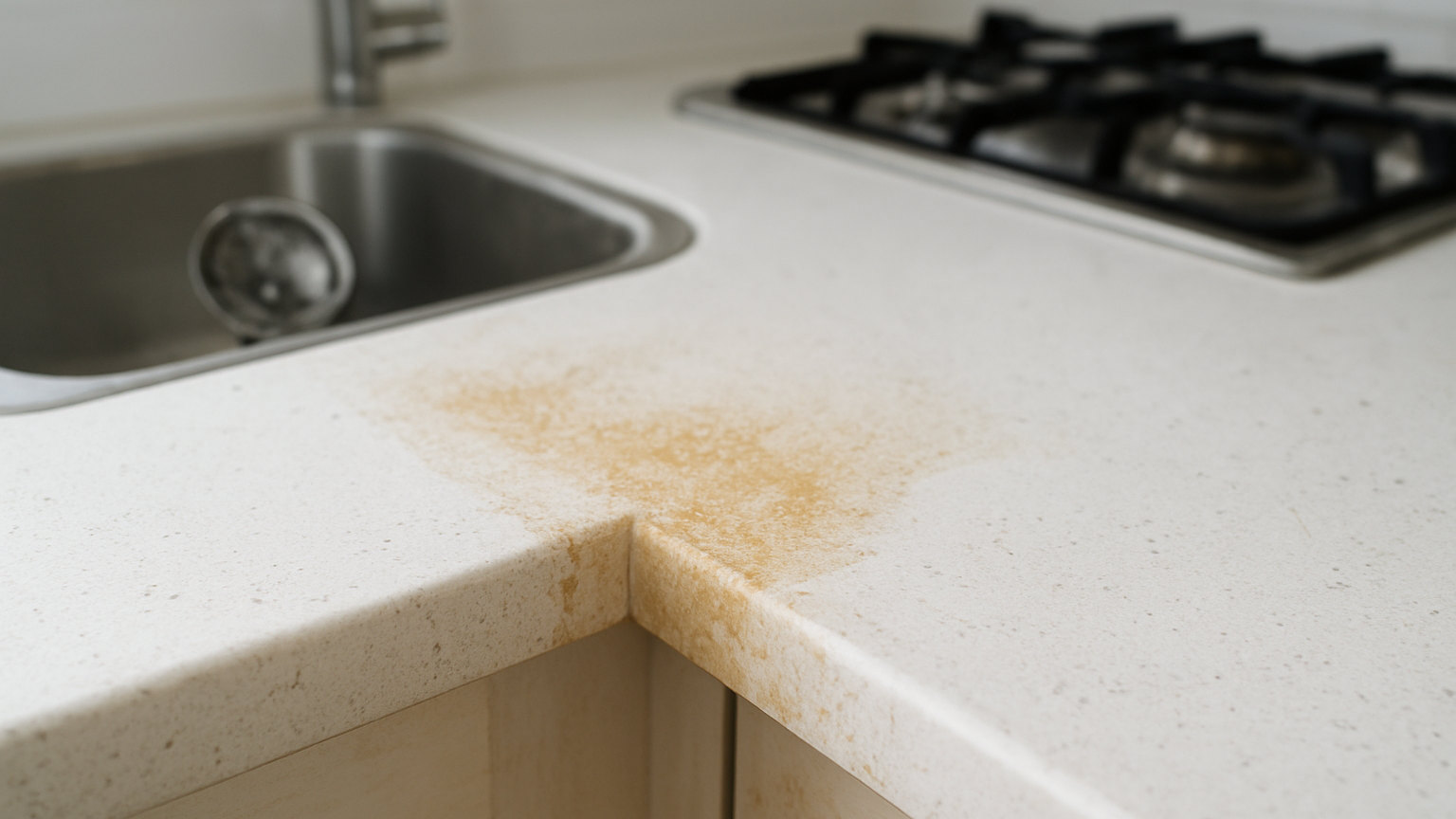
The sticky yellowish film on kitchen cupboard doors is airborne cooking grease that has settled and hardened, and it is not removed by a general purpose spray and a quick wipe. What removes it is a degreasing detergent, warm water and a little patience – and the ordinary washing up liquid under the sink is a degreasing detergent by design.
Why do cupboards get sticky in the first place?
Frying and roasting send fine droplets of fat into the air. Those droplets settle on cool surfaces and gradually oxidise, which turns a slight greasiness into a hard tacky varnish that grabs dust. The worst affected doors are the ones nearest the hob, followed by the wall units on the same side of the room.
Handles are a separate problem: they collect grease from hands rather than from the air, and they need doing more often than the doors around them.
What actually removes it?
Warm water and washing up liquid, applied generously and given a minute to work. Detergent molecules surround fat and lift it into the water, exactly as they do on a roasting tin, and cupboard grease needs no different chemistry.
The technique that makes the difference is dwell time. Wet the surface, leave it for sixty seconds, then wipe. Trying to lift hardened grease in a single pass is what leads people to reach for something harsher.
What is the step by step method?
- Mix a few drops of washing up liquid into a bowl of warm water – enough to feel slippery, not a bowl of foam.
- Wring out a microfibre cloth so it is damp rather than dripping, and wipe the door.
- Leave the wet film on the surface for a minute on badly affected doors.
- Wipe again with the same cloth, rinsing it in the bowl frequently. A cloth that is already loaded with grease simply moves it about.
- Go over the door with a second cloth wrung out in clean water.
- Dry immediately with a dry cloth, working bottom to top on gloss doors so no drips run over an area you have already dried.
What works on grease that has hardened for years?
Add a little more detergent and considerably more dwell time before you consider anything stronger. A cloth soaked in warm soapy water and laid flat against the worst patch for five minutes will soften almost anything. Bicarbonate of soda made into a thin paste gives mild abrasion for stubborn spots, but it must be used gently and never on gloss or on painted surfaces where it can dull the finish.
A degreaser marketed for kitchens will work, and so will a small amount of white vinegar in the water on laminate or melamine doors. Test any of these on the inside of a door first.
Which surfaces need a different approach?
- High gloss acrylic or lacquered doors – soft cloths only. Any abrasive, including a melamine sponge, leaves fine scratches that show as a haze under kitchen lights and cannot be undone.
- Painted and hand painted units – mild detergent, minimal water, dry immediately. Avoid anything alkaline or abrasive, which lifts the paint at the edges.
- Solid wood and oiled wood – damp cloth, never wet, dried at once. Water sitting in the grain raises it. Re-oil occasionally rather than scrubbing.
- Vinyl wrapped doors – fine with soapy water but not with heat or steam, which lifts the wrap at the edges and around the handles.
- Laminate and melamine – the most forgiving, and the only group where a stronger degreaser is a safe default.
Why does it come back so quickly?
Because the source has not changed. A film reappears within weeks in a kitchen where a lot of frying happens without extraction. Two things slow it down considerably: using the extractor hood every time you cook rather than only when something smokes, and washing the extractor filter regularly, because a saturated filter stops capturing grease and simply recirculates it.
Lids on pans and a splatter guard when frying both help, as does wiping the doors around the hob weekly, since ten seconds on fresh grease saves ten minutes on hardened grease later.
Is a steam cleaner a good idea?
On laminate and painted MDF, no. Steam drives moisture into the joints and behind the edging, and it is a common cause of swollen door edges and lifted vinyl. Kitchen cupboards are a place where hot soapy water beats the more impressive tool.