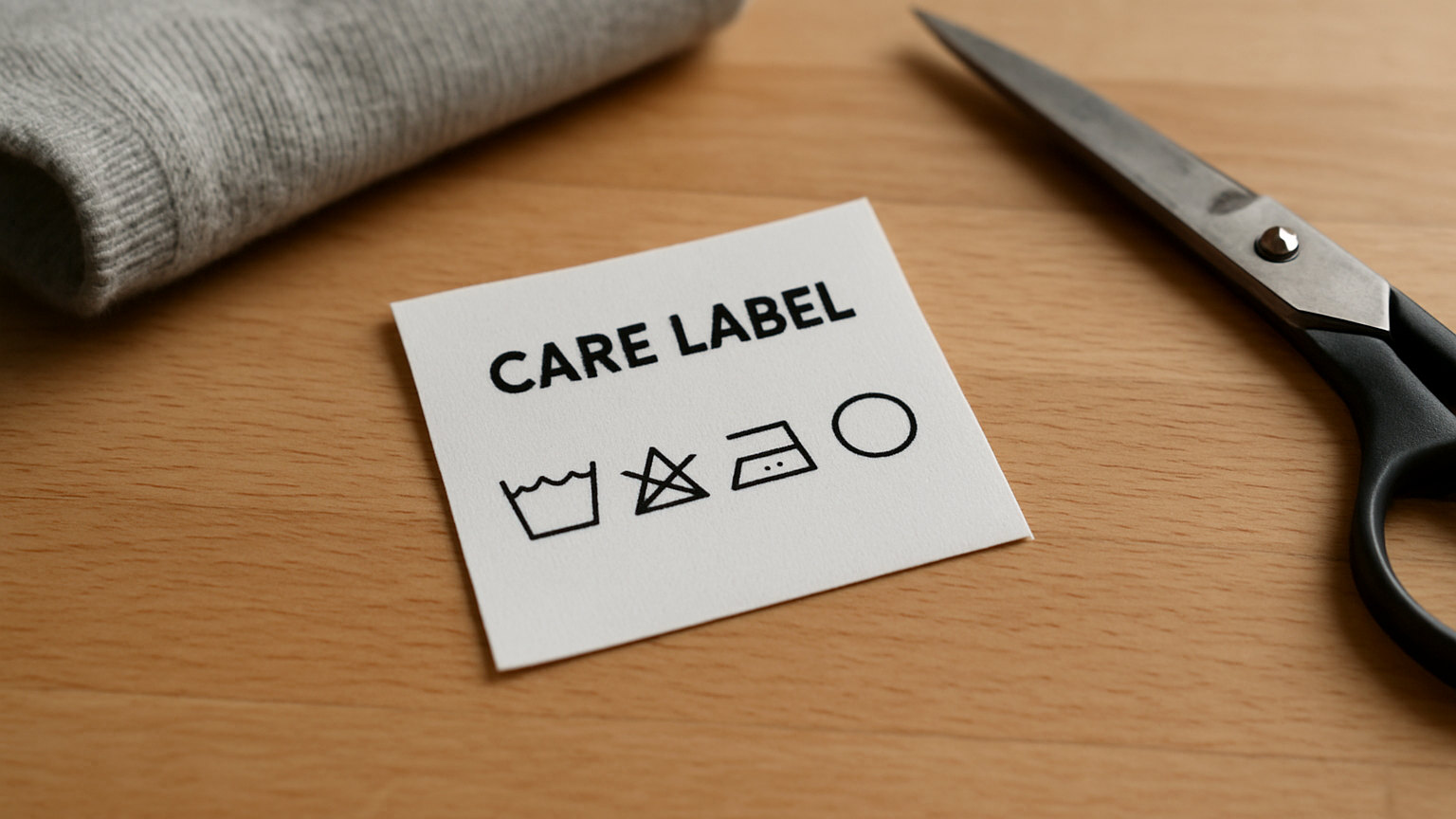
Care labelling developed separately in different regions, and although the systems look similar they are not identical. Clothing sold internationally often carries two or three sets, which is why some labels are far longer than the garment seems to warrant.
What is the European system?
The one used in the UK and across Europe, based on an international standard, using five symbols: the wash tub, the bleaching triangle, the drying square, the iron and the professional cleaning circle.
Its distinctive feature is that the wash tub usually contains a number giving the maximum temperature in degrees Celsius, which is unambiguous and easy to apply.
How does the American system differ?
It uses the same five basic shapes, with some notable differences.
- The wash tub commonly shows dots rather than a number, on a scale from one dot for cold up to six for very hot.
- The drying square uses a circle for tumble drying and lines or curves for natural drying, broadly as in Europe.
- Written instructions appear more often alongside the symbols.
- The bleach triangle sometimes contains the letters CL rather than diagonal lines.
The practical effect is that an American label may give a temperature in dots that you have to convert, and one dot means cold rather than 30 degrees specifically.
What about the Japanese system?
Japan revised its labelling to align more closely with the international standard, and modern Japanese labels are broadly readable to anyone familiar with the European symbols. Older garments carry a distinctly different set, including symbols that look unfamiliar and numbers alongside them.
If you encounter an older Japanese label, the safest approach is to treat the garment cautiously rather than guess.
How do you read a label with two sets?
Find the one you recognise and follow it, and if the two appear to disagree, follow the more cautious. A discrepancy usually reflects rounding between scales rather than a genuine difference, but there is no way to know which is the stricter interpretation without checking both.
The fibre content label is the same in every system and is a useful tiebreaker.
Why do the temperatures not match exactly?
Because the scales were set independently. European numbers are specific values; American dots are bands. One American dot corresponds roughly to cold water, which might be anywhere from 15 to 30 degrees depending on the supply. Two dots is warm, around 40. Three is hot, around 50 to 60.
Domestic machines also differ. American machines have traditionally been top loading with a different wash action, which is part of why the advice diverged.
Does it matter for online shopping?
It can. Clothing bought directly from overseas sellers sometimes carries only the local labelling, and occasionally none at all if it has not been prepared for the UK market. UK and EU rules require fibre content labelling on garments sold here, so an item arriving with no composition label is a reasonable signal about the seller.
Are the symbols legally required?
Fibre content labelling is a legal requirement in the UK and EU. Care symbols are not; they are voluntary, though almost universally used because manufacturers want the protection they provide.
That is worth knowing, because it explains why a garment can legitimately arrive with a full composition label and no care instructions at all.
What is the safe approach with an unfamiliar label?
Read the fibre content, apply the cautious default of a cool gentle wash and flat drying, and test for colour fastness first. Almost no garment is damaged by being treated more gently than it needed, and the symbols exist to prevent the opposite mistake.
Do the machines differ too?
They do, which is part of why the advice diverged in the first place. European front loading machines heat their own water and run long cycles with a tumbling action. Traditional American top loaders take hot water from the supply and agitate rather than tumble. A label written for one is not a perfect instruction for the other, and the symbols are a compromise between them.