Two modifiers appear across several care symbols and are easily confused. Dots indicate temperature. Bars indicate how gentle the process needs to be. They are independent instructions, and the bars are the one almost nobody notices.
What do the dots mean?
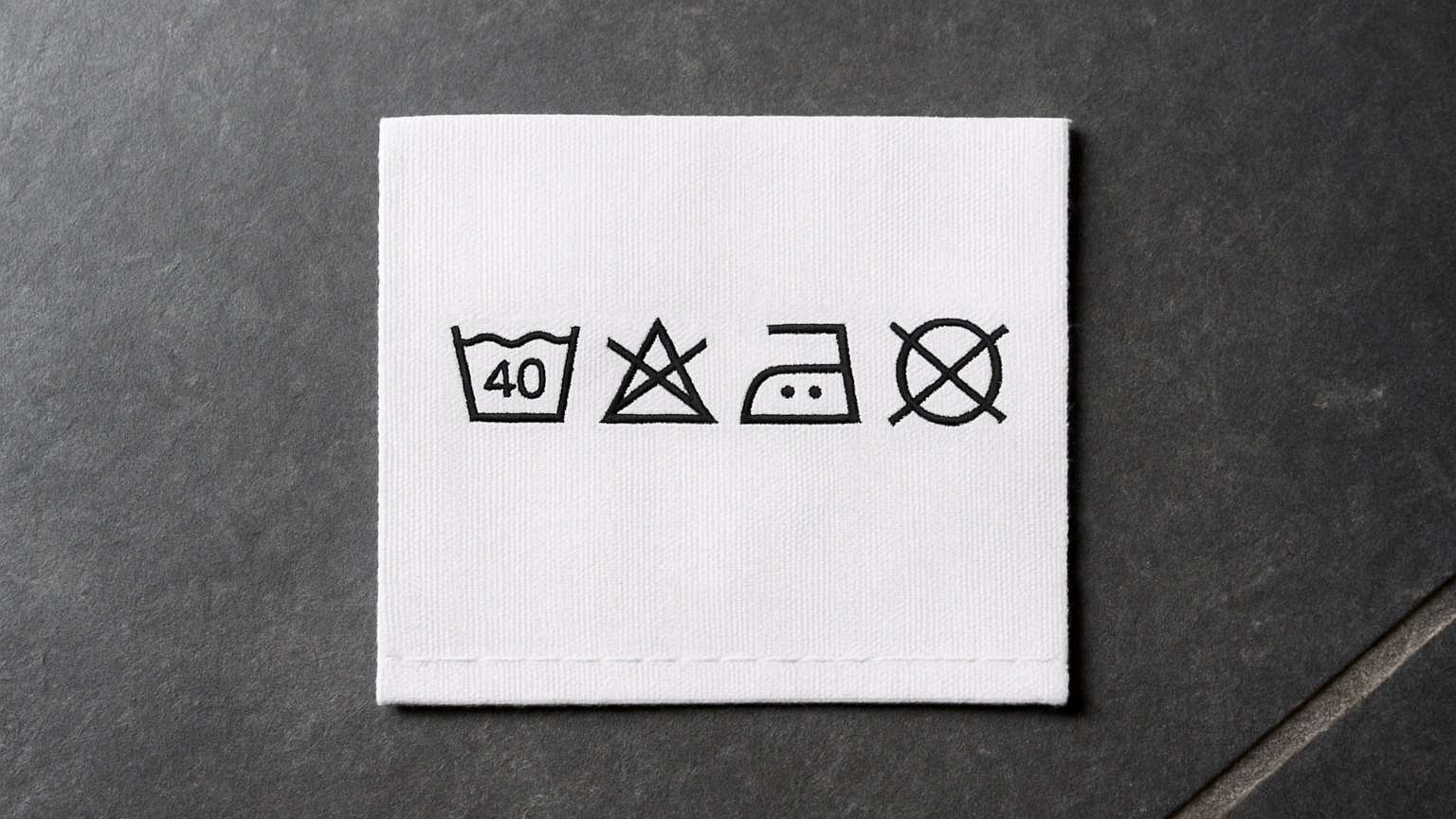
Dots are a temperature scale, used inside the wash tub in some systems and inside the tumble dryer square and the iron in most.
- One dot – the coolest setting. Around 30 degrees for washing, low heat for drying, about 110 degrees for ironing.
- Two dots – medium. Around 40 to 50 degrees for washing, medium heat for drying, about 150 degrees for ironing.
- Three dots – hot. Around 60 degrees and above, high heat for drying, about 200 degrees for ironing.
Six dots are theoretically possible in the washing scale, going up to 95 degrees, though they are rarely seen. In the UK and Europe the wash tub usually shows a number in degrees instead, and the dots are reserved for the iron and the dryer.
What do the bars mean?
Bars sit underneath a symbol and indicate reduced mechanical action, meaning less agitation, less friction and a lower spin.
- No bar – normal cycle. Full agitation and full spin.
- One bar – a synthetics or permanent press cycle. Gentler agitation, more water, reduced spin.
- Two bars – a delicate, wool or hand wash cycle. Minimal agitation and a very low spin or none.
Why do the bars matter so much?
Because a great deal of laundry damage is mechanical rather than thermal. Wool felts because of agitation. Knitwear pills and stretches because of friction. Structured items are crushed by the spin. None of that is prevented by getting the temperature right.
A tub marked 40 with two bars underneath is telling you that the temperature is not the issue and the cycle is. Washing that garment at 40 on a normal cotton programme follows half the instruction and ignores the half that matters.
How do the bars map to a machine?
Roughly, since programme names vary by manufacturer. One bar corresponds to a synthetics, easy care or permanent press programme. Two bars correspond to a delicates, wool or hand wash programme.
If your machine does not label things that way, look for the cycle with the lowest spin speed and the shortest agitation time, and reduce the spin manually.
Do the dots and bars appear on the same symbol?
They can, and frequently do. A tumble dryer square with one dot and one bar means low heat on a gentle cycle. An iron with two dots and no bar means medium heat, normal use.
Read them as two separate pieces of information rather than as one combined rating.
Which is more important?
It depends on the fibre. For cotton, temperature matters most, since cotton tolerates agitation well and shrinks with heat. For wool, silk and knitwear, the bars matter far more, since these felt, stretch and abrade under mechanical action at any temperature.
For anything containing elastane, temperature is the critical one, since heat degrades the elastic fibres irreversibly.
What about the tumble dryer square?
The same rules apply. A circle inside a square means tumble drying is allowed, and the dots inside the circle set the heat. Bars underneath the square mean a gentle drying cycle. A crossed out square and circle means do not tumble dry at all.
Is there a quick way to remember it?
Dots mean degrees, bars mean be gentle. Both alliterate, which is the only reason anyone remembers them, and it covers every symbol on a standard care label.
Where do the bars matter most?
On the wash tub, by a wide margin. Bars under the iron and the dryer are less common and less consequential, since most people already moderate both. Bars under the tub are the instruction that decides whether a wool jumper survives, and they are the easiest to miss because the temperature number sits above them and draws the eye.