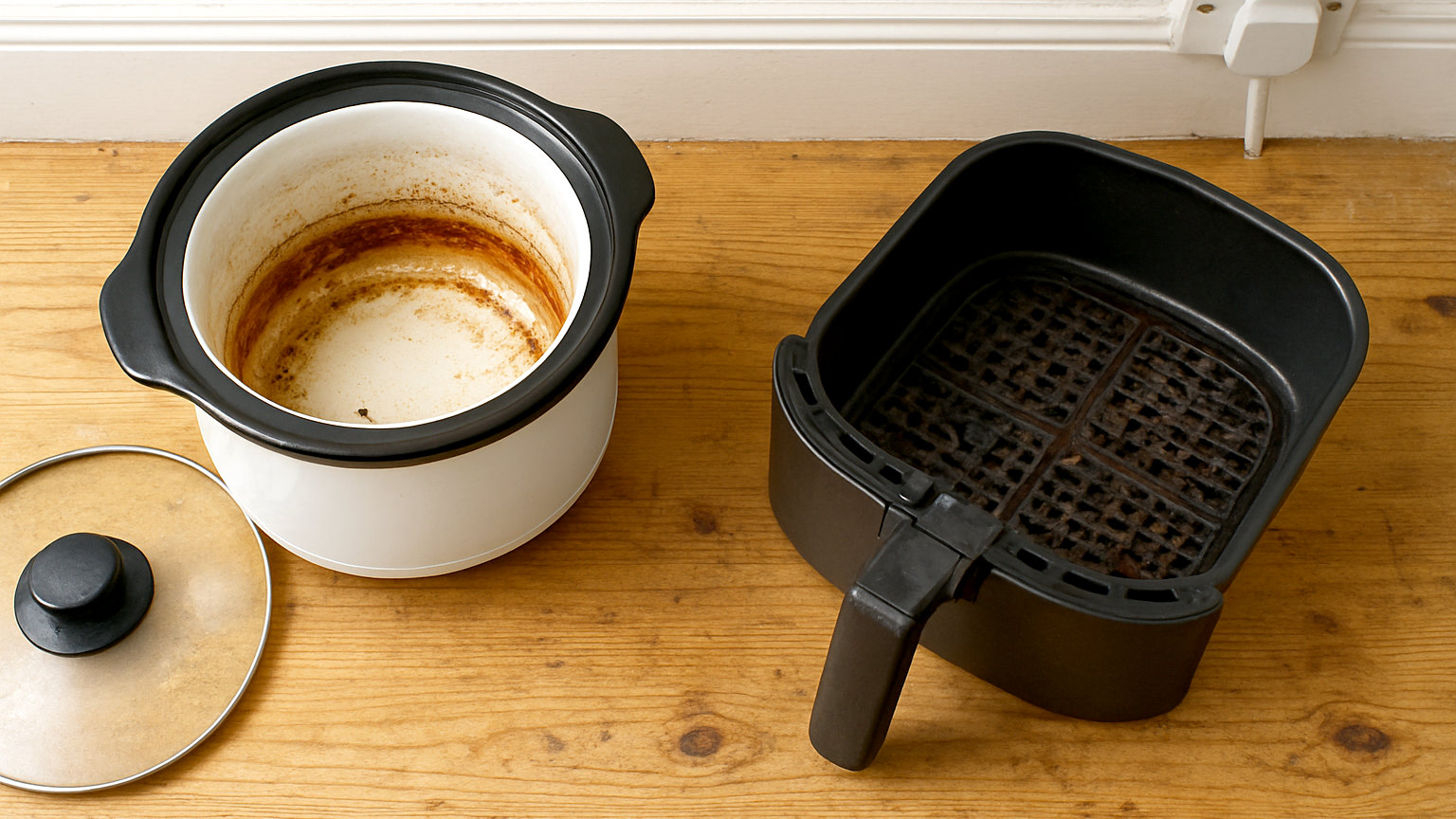
A slow cooker is a ceramic pot in a heated metal housing. The pot itself washes easily; the difficulty is the ring of baked on residue that forms just above the level of the food, where liquid has evaporated and cooked onto the glaze over eight hours.
What is the basic routine?
- Unplug the base and let everything cool before handling.
- Lift out the ceramic pot and the lid.
- Fill the pot with warm soapy water and leave it to soak.
- Wash the lid separately, including the rim and the vent hole if it has one.
- Wipe the heating base with a damp cloth, never immersing it.
- Wash and dry the pot, and store it out of the base so air can circulate.
Why does thermal shock matter?
Because a hot ceramic pot filled with cold water, or a cold pot placed into a preheated base, can crack. The crack is often invisible at first and the pot fails later, sometimes mid cook.
Let the pot cool before washing, and let refrigerated ingredients come towards room temperature before the pot goes on. Never put a hot pot straight onto a cold worktop either.
How do you remove the baked ring?
Soak first, always. Fill the pot with hot water and a squirt of washing up liquid and leave it for an hour or overnight. Most of the ring will then wipe away.
For what remains, make a paste of bicarbonate of soda and a little water, spread it over the ring, leave it for thirty minutes and work it with a non-scratch pad. A splash of white vinegar over the bicarbonate helps lift it.
For a very stubborn ring, fill the pot with water, add a cup of white vinegar, and run the slow cooker on low for an hour. The gentle heat and steam release almost everything.
What should not be used on the pot?
- Scouring pads and wire wool, which scratch the glaze and make future staining worse.
- Metal utensils during cooking, for the same reason.
- Bleach, which the glaze can absorb through any crazing.
- Sudden temperature changes.
Can it go in the dishwasher?
Most ceramic pots and glass lids are dishwasher safe, and it is worth checking the manual. They are heavy and take up a lot of space, so hand washing after a soak is frequently quicker.
The heating base never goes in a dishwasher and is never immersed.
How do you clean the heating base?
Unplug it and let it cool. Wipe the inside with a cloth wrung out in warm soapy water, then dry. Food spilled between the pot and the base bakes on and should be softened with a damp cloth laid over it rather than scraped.
Check there is nothing under the pot before each use, since debris there affects heat transfer.
What about the lid?
Glass lids stain with a cloudy film from mineral deposits and steam. Soaking in a solution of white vinegar clears it. Check the rubber seal if the lid has one, and the vent hole, which can block.
Do not put a hot glass lid into cold water.
What about a multi cooker?
Pressure and multi cookers have more parts. The sealing ring should be removed and washed after every use, since it absorbs smells and is the usual cause of last week curry flavouring this week porridge. Keeping two rings, one for savoury and one for sweet, is a common solution.
The lid, the float valve and the steam release all need checking and cleaning regularly.
Can you use a liner?
Slow cooker liner bags are sold and they work, reducing the clean up to lifting the bag out. They need to be the correct size and must not touch the sides above the food line, where they can melt. For anyone who finds the baked ring the main deterrent to using a slow cooker, they solve the problem entirely.