A gas hob has more removable parts than any other cooking surface, and that is an advantage. Almost everything that gets dirty lifts off and can be soaked, which means the cleaning is mostly a matter of patience rather than effort. The part that matters most for performance is the burner crown, where small gas ports block with spillage.
What is the routine clean?
- Wait until everything is cool, and turn the gas off at the control knobs.
- Lift off the pan supports and the burner caps.
- Lift out the burner crowns where they are removable.
- Put all of it into hot water with washing up liquid and leave to soak.
- Wipe the hob surface with hot soapy water, working around the fixed parts.
- Scrub the soaked components with a nylon brush, paying attention to the ports.
- Rinse everything, dry completely, and refit in the correct positions.
Everything must go back dry. A wet burner crown will not light properly and can corrode.
Why do the gas ports matter?
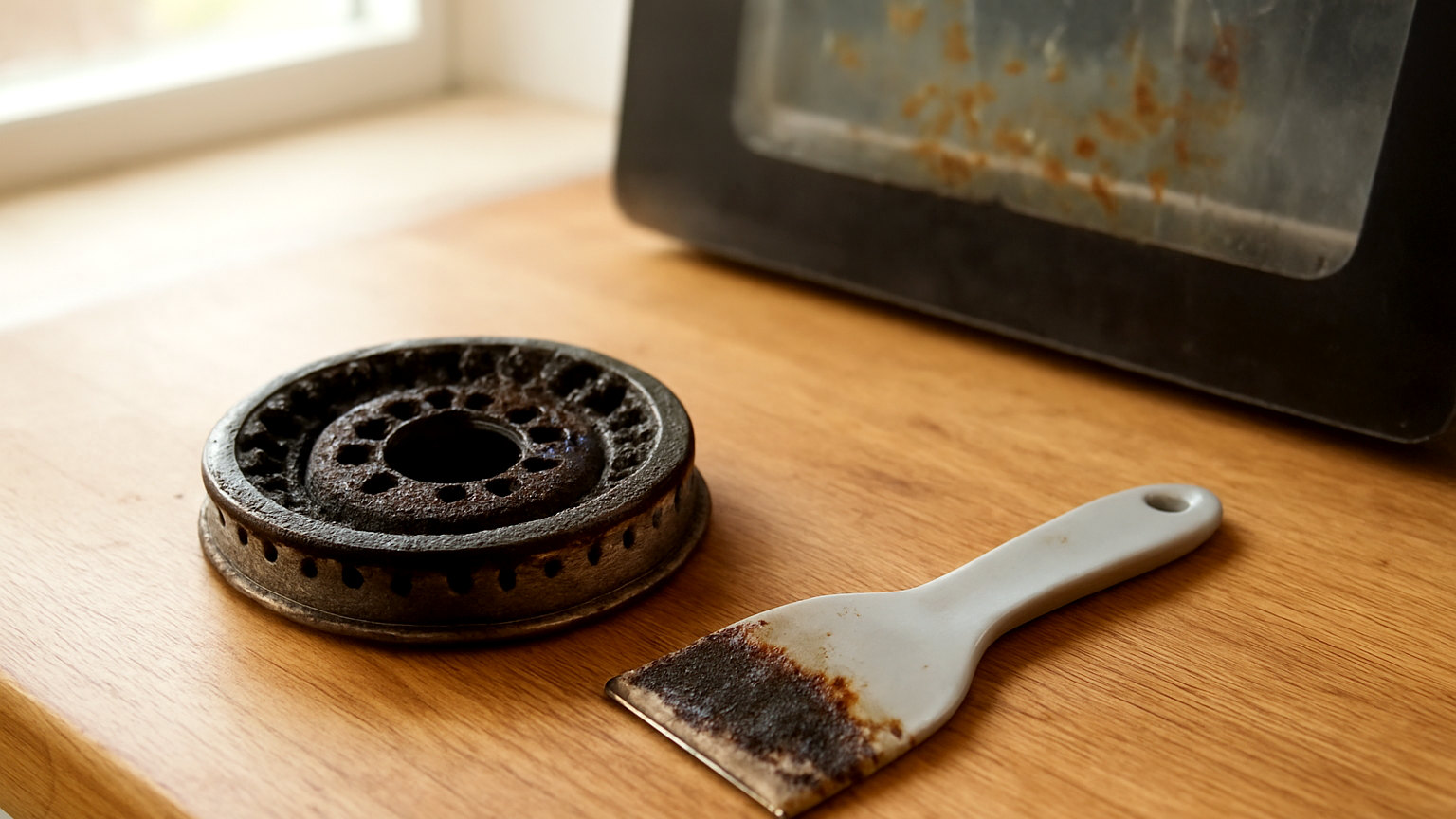
Because each small hole around the burner crown delivers gas to the flame, and a blocked port produces an uneven flame, poor heat distribution and a burner that lights unreliably. Spillage and grease are the usual cause.
Clear each port with a pin, a paperclip or a stiff brush after soaking, working gently so the hole is not enlarged or distorted. Do not use anything that could break off inside.
What does the flame colour tell you?
A healthy gas flame is predominantly blue with a well defined inner cone and it sits steadily on the burner. A yellow or orange flame, or one that lifts away from the burner and flickers, suggests incomplete combustion, and the most common cause is blocked ports or a dirty burner crown.
If cleaning does not restore a blue flame, or if there is sooting on pans, that needs a Gas Safe registered engineer rather than more cleaning. Incomplete combustion produces carbon monoxide.
What must be kept dry?
- The ignition electrodes, the small ceramic tipped pins beside each burner.
- The gas jets in the centre of each burner position, which should be wiped rather than soaked.
- The area under the control knobs.
- Any thermocouple, the small probe next to the burner on hobs with flame failure protection.
Never pour water onto the hob surface or spray cleaner directly at the burner area. Apply it to a cloth instead.
How do you clean the pan supports?
Soak them, which is the only approach that works on cast iron supports with baked deposit. Hot water with soda crystals or a biological powder overnight, then a nylon brush.
Enamelled cast iron supports can go in a dishwasher on most hobs, though repeated cycles can dull the finish. Check the manual. Dry them thoroughly, since chips in the enamel will rust.
What about the hob surface?
Stainless steel takes hot soapy water and a cloth, wiped in the direction of the grain, and a cream cleaner for stubborn marks. Enamel takes the same and should not meet abrasives. Glass topped gas hobs take the same care as a ceramic hob: no abrasives, and a specialist hob cleaner for burnt on residue.
How do you deal with burnt on spillage?
Lay a hot damp cloth over it for ten minutes to soften it, then use a plastic scraper. On stainless steel a cream cleaner and a non-scratch pad will finish it. Avoid metal scrapers on any hob surface.
What should be done after every use?
Wipe the surface while it is warm rather than hot, which takes fifteen seconds and prevents almost everything. Boiled over liquid dealt with immediately is nothing; the same spill baked on through three more cooking sessions needs a soak and a scraper.
What about the control knobs?
They pull straight off on most gas hobs, which makes both the knobs and the fascia behind them far easier to clean. Wash them in hot soapy water, dry them, and wipe the exposed spindle area with a barely damp cloth rather than spraying anything at it. Note the order if the knobs differ, and never force one that does not want to come off.