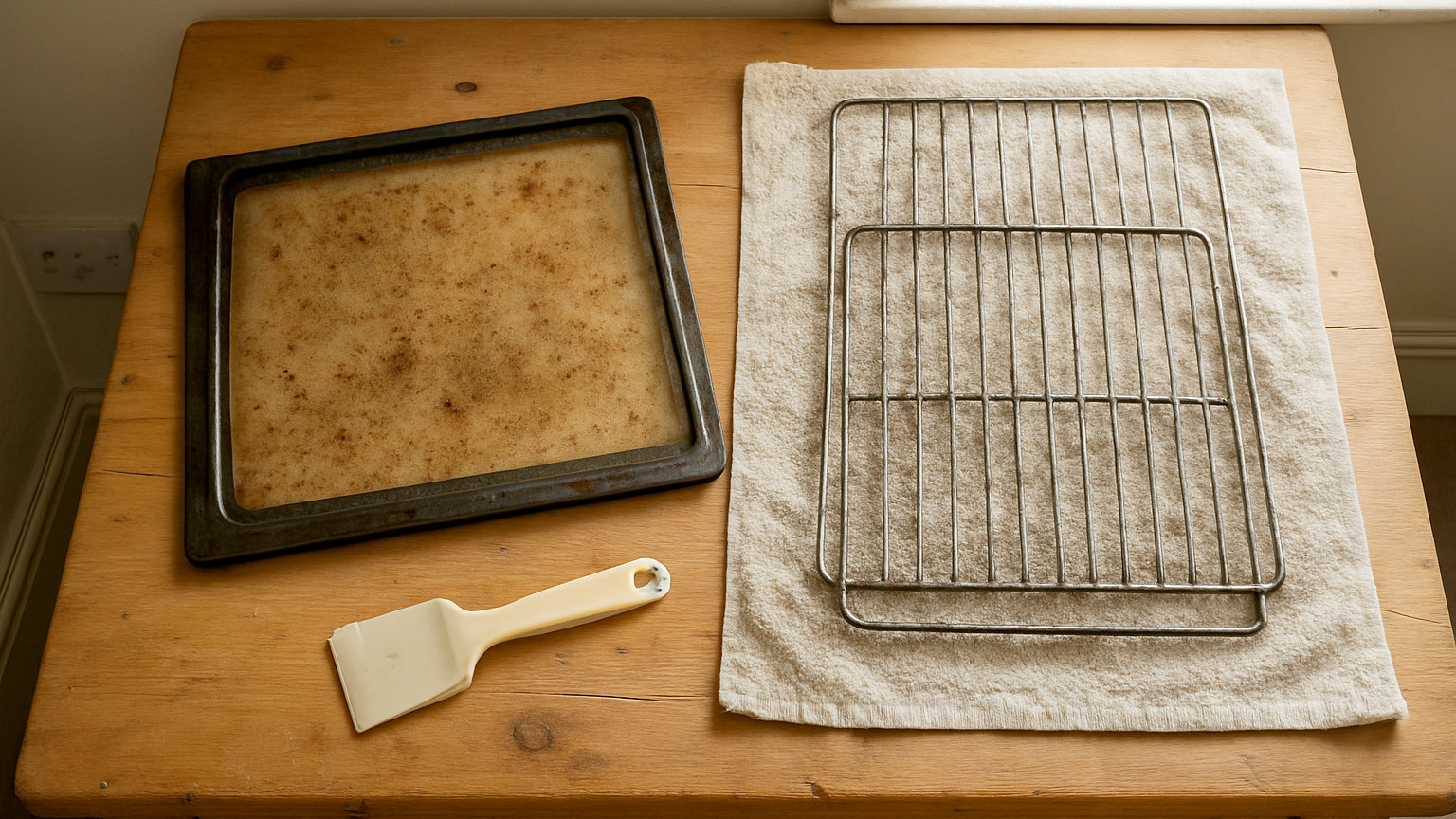
A grill pan collects concentrated fat directly beneath food cooked at high heat, and the rack above it takes the charred residue. Between them they are the greasiest item in most kitchens. They are also frequently rinsed rather than cleaned, which is how a grill pan becomes a hard black layer that resists everything.
What is the routine after each use?
Deal with it while it is still warm rather than cold. Pour off the fat into a container for the bin, not down the sink, and wipe the pan out with kitchen paper. Then wash in hot soapy water.
Warm fat wipes away. Cold fat sets into a solid layer that needs soaking. The difference is about ten minutes of timing.
What is the method for a neglected pan?
- Fill the pan with hot water and add a generous scoop of soda crystals or a biological washing powder.
- Put the rack in as well if it fits, or soak it in the sink.
- Leave it for several hours or overnight.
- Pour away and scrub with a nylon brush or a non-scratch pad.
- Repeat the soak if the deposit is heavy, which is normal.
- Rinse thoroughly and dry completely.
Soda crystals are strongly alkaline and cut baked grease far better than washing up liquid alone. They should not be used on aluminium pans, which they will discolour and pit.
What about the wire rack?
Soak it alongside the pan. A wire rack with charred residue between the bars is difficult to scrub and easy to soak, and a nylon brush afterwards deals with what remains.
Enamelled racks can usually go in a dishwasher. Bare wire racks will rust in a dishwasher and should be washed by hand and dried immediately.
Can a grill pan go in the dishwasher?
Most enamelled ones can, and the results are often disappointing on heavy grease, since dishwasher detergent is formulated for food residue rather than baked fat. It can also leave enough grease in the machine to affect the next load.
Soak first and use the dishwasher for the finishing rather than the main job.
How do you clean the grill element and the cavity?
Let it cool completely and turn the power off at the wall for an electric grill. Never apply any liquid or cleaner to the element itself. Wipe the cavity around it with hot soapy water on a well wrung cloth, and use a plastic scraper on any deposit.
For a grill inside an oven, the element is usually at the roof and the same rules apply: nothing wet on the element, and no caustic cleaner near it.
Loose carbon on an element burns off the next time it is used, which is normal and produces some smoke.
Why is accumulated grease a fire risk?
Because grill elements reach several hundred degrees and sit directly above the pan. Fat that has built up in the pan or on the element can ignite, and grill fires are among the more common kitchen fires.
Never leave a grill unattended, never line a grill pan in a way that blocks the drainage or covers the element, and empty the fat after each use.
What about a griddle pan or a health grill?
Ridged griddle pans need soaking and a stiff brush along the grooves, and cast iron ones should not be soaked at all. Health grills with removable plates are usually dishwasher safe, and the plates should be removed and washed after every use rather than wiped.
Non-stick plates must never meet an abrasive, which is what destroys them.
How do you make it easier next time?
Line the pan with foil before grilling, which catches the fat and lifts straight out, provided it does not block any drainage hole. Pour the fat off while warm. And wash the pan on the day rather than putting it back in the oven dirty, which is how the deposit builds.