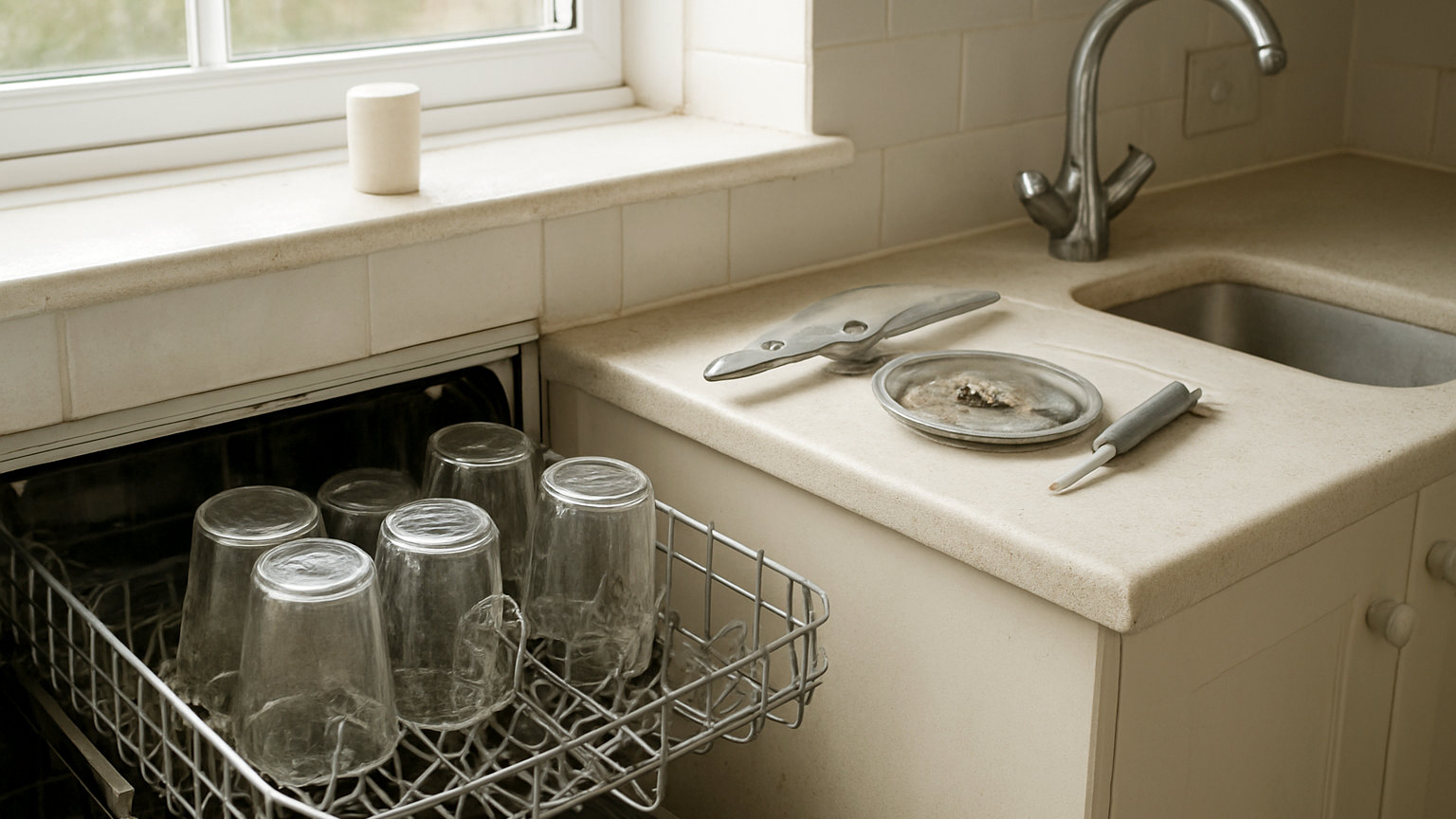
Dishwashers are simpler than washing machines and fail for a smaller number of reasons. Neglecting the filter, ignoring water hardness and leaving the door shut between cycles account for most of the problems people experience.
What is the weekly routine?
- Remove and scrub the filter, and wipe the sump beneath it.
- Wipe the door seal and the lip below the door.
- Check the spray arms turn freely.
- Leave the door ajar after each cycle to dry.
Ten minutes a week, and it prevents most of the smells and performance complaints.
What is the monthly routine?
Run an empty cycle on the hottest programme with a dishwasher cleaner, a cup of white vinegar in a bowl on the top rack, or citric acid. Take out the cutlery basket and wash it. Check the salt and rinse aid levels.
What is the quarterly and annual routine?
- Remove and soak the spray arms, clearing the jets.
- In a hard water area, run a citric acid descaling cycle.
- Pull the machine out once a year and check the fill and drain hoses.
- Check the drain hose still has its high loop.
- Check the sink waste connection and trap.
- Clean the floor and the sides while it is out.
What shortens a dishwasher life?
Scale on the heating element, which is the most common cause of failure in hard water areas and is entirely preventable with the correct hardness setting and salt.
Beyond that: debris reaching the pump because the filter is never cleaned, overloading so the door hinge and racks take strain, and putting items in that shed labels, glass or stones.
Why does the hardness setting matter so much?
Because it governs how much softening the machine does. Set correctly with salt topped up, the water reaching the element is soft and almost no scale forms. Set wrong or left on default, scale accumulates quietly for years until the element fails.
Find your local hardness from your water supplier, find the setting in the manual, and set it once. It is five minutes that materially extends the life of the appliance.
What symptoms should you act on?
- Standing water in the base after a cycle.
- Dishes neither clean nor dry, which suggests the heating element.
- Water on the floor, however small.
- A grinding or rattling noise, which usually means something loose in the sump.
- Repeated error codes.
- A door that no longer closes squarely or a failing latch.
What about the racks and baskets?
The plastic coating on the rack tines chips over time, exposing bare steel that rusts and can mark dishes. Repair kits with a coloured sealant are sold for this and are worth using early.
Rack wheels and runners wear and are available as spare parts, which is far cheaper than replacing a machine because the rack sags.
What is the realistic lifespan?
Around seven to twelve years for a domestic machine used daily, with well maintained examples in soft water areas going considerably longer. The common failures are the heating element, the drain pump, the door seal and the control board.
The first three are usually economic to repair on a machine that has otherwise been looked after.
What is the single most useful habit?
Cleaning the filter weekly. It takes two minutes at the sink, it prevents the smell, it prevents the gritty dishes, and it keeps debris away from the drain pump where it does real damage. Almost every dishwasher complaint people have begins there, and almost nobody does it.
Does running it more often help or hurt?
Running a full machine regularly is better than letting it stand loaded for days, both for the smell and because dried food is considerably harder to remove. A dishwasher uses the same water whether it is half full or full, so waiting for a full load is sensible, and waiting three days with dirty plates sitting inside is not. Use the rinse programme if the gap will be a long one.