Proprietary wine stain removers do work, and the effective ones rely on the same chemistry as a tub of oxygen bleach. Their advantages are convenience, a suitable concentration and a form that stays where you put it. Their disadvantage is cost per use, which is many times higher than the generic equivalent.
What is in them?
Most contain an oxidising agent, usually hydrogen peroxide or a percarbonate that releases it, along with surfactants to help it penetrate the fibre and sometimes a thickener so the product stays on a vertical or carpeted surface.
Some include enzymes, which are useful if the spill contains food as well as wine. A few use a solvent base, intended for upholstery marked as solvent only.
Are the branded products better than oxygen bleach?
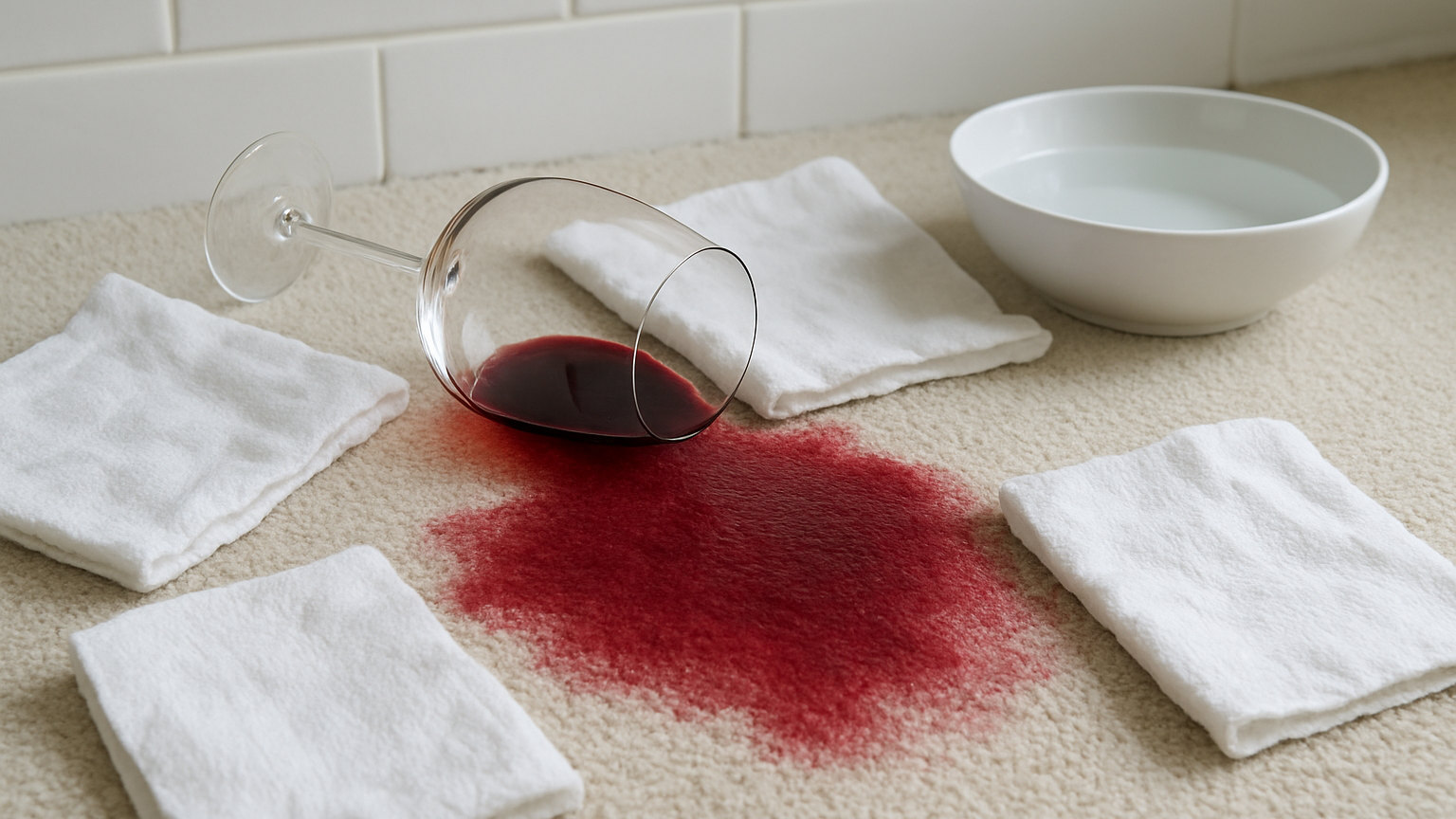
Not chemically, in most cases. What they offer is convenience: no measuring, no dissolving, and a gel or foam that clings rather than running off. For a carpet or a sofa, where you cannot soak the item, that formulation genuinely matters.
For clothing that can be submerged, a tub of oxygen bleach used as an overnight soak will match or beat almost any spray, at a small fraction of the cost.
When is a specialist product worth buying?
- For carpet and upholstery, where a clinging formulation is an advantage.
- For a spill kit kept in a car or a bag, where portability matters.
- For solvent only upholstery, where household alternatives are not safe.
- For immediate treatment away from home, where a pen or wipe buys time.
- For anything valuable, where a tested product is safer than improvisation.
Do the stain removal pens work?
As first aid, reasonably. They apply a small amount of surfactant and water to a fresh mark, which dilutes it and keeps it wet until the garment can be treated properly. That is genuinely useful at a restaurant table.
They are not a treatment. A garment treated with a pen still needs washing, and expecting the pen alone to remove a red wine stain will disappoint.
What should you look for on the label?
Hydrogen peroxide or sodium percarbonate for tannin stains, which is what wine needs. Enzymes if the spill involved food. A note that the product is colour safe, and instructions specifying a contact time, which is a sign it is meant to work chemically rather than by being wiped off immediately.
Products that promise to remove every stain are usually a compromise, since grease and protein and tannin need different chemistry.
Do they damage fabric?
Used correctly, rarely. The risks are using an oxidising product on wool or silk, which are protein fibres, and using anything on a dye that is not fast. Every product should be tested on a hidden area first, and that is true of the branded ones as much as of household remedies.
Leaving a product on far longer than the label states is the other common cause of a lightened patch.
What is the cheap equivalent?
For fabric, oxygen bleach as an overnight soak. For white cotton, one part hydrogen peroxide to two parts washing up liquid, dabbed on and left twenty minutes. For carpet, cold water with a drop of washing up liquid followed by thorough extraction, then a diluted hydrogen peroxide solution if a mark remains on colourfast synthetic fibre.
Those three cover the majority of wine stains for the price of one bottle of anything branded.
What is the honest verdict?
Worth having one clinging product for carpet and upholstery, where the format is the point. Not worth buying for clothing, where a soak in oxygen bleach does the same job better and cheaper. And no product of any kind substitutes for blotting immediately, which remains the step that decides the outcome.
How should they be stored and how long do they last?
Sealed, cool and out of direct light. Products based on hydrogen peroxide lose potency over time and faster once opened, so a bottle that has been in a cupboard for three years will be noticeably weaker than the label suggests. If a product that once worked no longer seems to, check the date before concluding the stain is permanent.