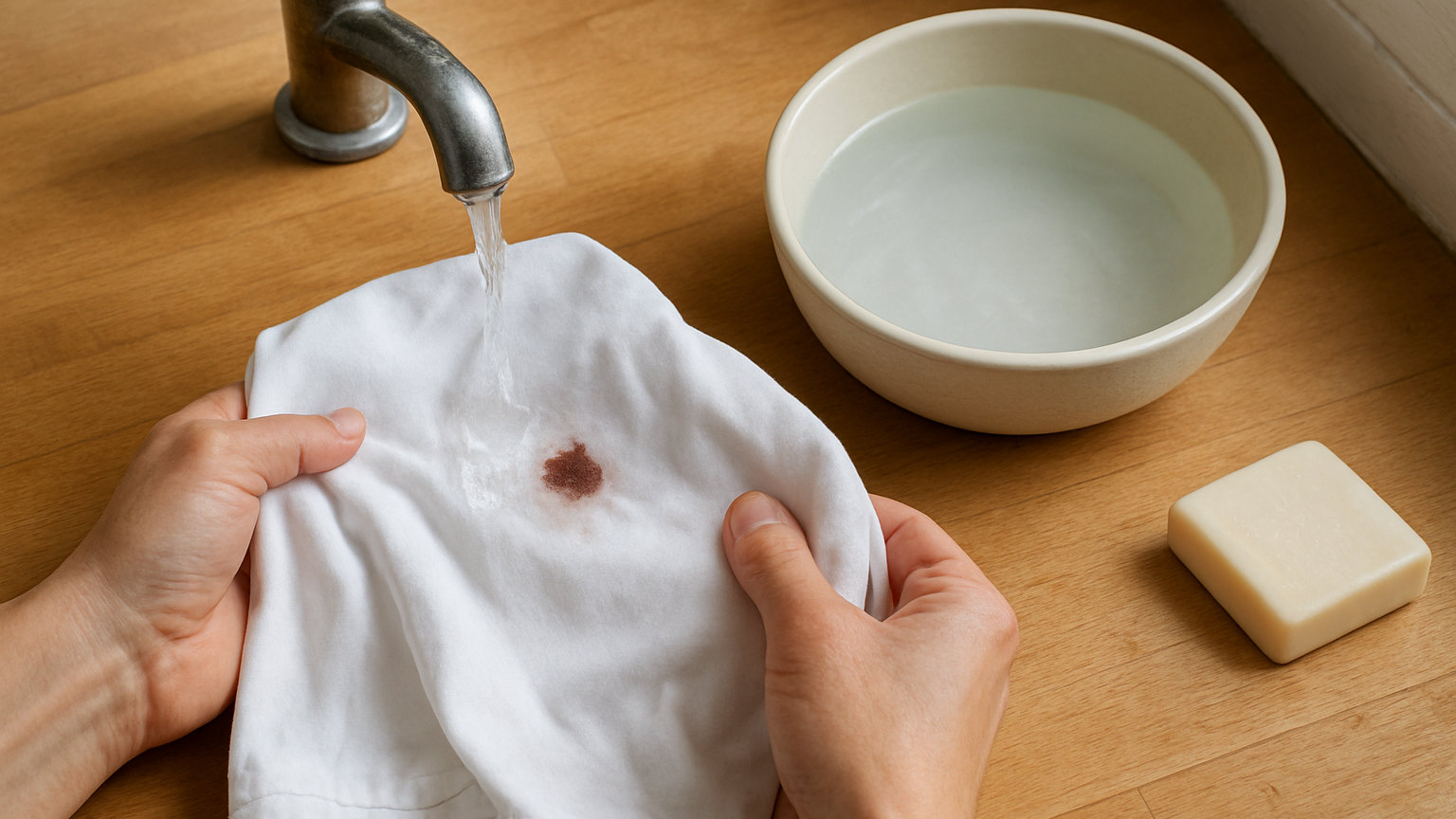
A dried blood stain looks far worse than it is. Provided it has never been through hot water or a tumble dryer, the protein has simply dried rather than coagulated, and it can be rehydrated and broken down. The treatment is time rather than force: a long cold soak does what no amount of scrubbing will.
What is the method?
- Soak the item in cold water for at least an hour to rehydrate the stain.
- Change the water once, since the released material goes back into solution.
- Rub a biological detergent or an enzyme pre-treatment into the mark.
- Soak again in cold water with a full dose of biological detergent, for four hours or overnight.
- Rinse and check. Rub gently with a fingertip to help release what has loosened.
- Wash at 30 degrees with a biological detergent.
- Air dry and assess. Repeat the soak if there is partial improvement.
Why does the soak need to be cold?
Because warmth will set whatever protein has not yet been broken down, and that includes the portion deeper in the fibre that has not been reached. Enzymes work well in cool water and are destroyed by heat, so a cold soak with a biological detergent is doing two things at once.
Patience genuinely substitutes for temperature here.
What does hydrogen peroxide do?
It oxidises the haem pigment that gives dried blood its brown colour, and it works quickly. Apply a solution of one part hydrogen peroxide to two parts water directly to the mark and watch it fizz, which is the reaction taking place.
Leave it for a few minutes, blot, and rinse in cold water. Repeat if needed.
Test on a hidden seam first, since it will lighten some dyes. Do not use it on wool, silk or anything with a delicate colour.
What about bicarbonate of soda and salt?
A paste of bicarbonate of soda and cold water, applied to the mark and left for half an hour, helps on a dried stain and is safe on almost everything. Salt water is a traditional soak and has a mild drawing effect.
Both are useful and neither is as effective as a biological detergent, which attacks the protein directly rather than working around it.
How do you tell whether a stain has been heated?
Heated blood is a flat brown, often with a slightly stiff feel, and it will not soften or lighten at all during a long cold soak. Unheated dried blood is darker, more reddish brown, and it begins to release colour into the water within the first hour.
If four hours of soaking produces no change whatsoever, the protein has almost certainly been set.
Can a heat set stain be recovered?
Partially, sometimes. Repeated overnight soaks in cold water with a biological detergent, two or three times, often produce gradual improvement. On white cotton, follow with an oxygen bleach soak and drying in sunlight, which lifts the remaining discolouration.
Expect a shadow rather than a clean result, and accept that a heat set blood stain on a coloured synthetic is usually permanent.
What about very old stains?
Age alone matters less than heat. A blood stain that is years old but has never been washed hot will still respond to a long cold enzyme soak, sometimes surprisingly well. Give it overnight and repeat before concluding anything.
Old marks on stored linen also carry oxidation, so an oxygen bleach soak afterwards helps on white cotton.
What should you avoid?
Hot water at every stage. Scrubbing, which damages fibres without reaching the bonded protein. Chlorine bleach, which can react with blood to produce a yellow mark and weakens the fabric. And giving up after one attempt, since this is a stain that responds to repetition more than to strength.
Does the fabric affect the outcome?
Considerably. Cotton and linen release blood well and tolerate long soaks and oxygen bleach. Polyester holds the brown pigment more stubbornly. Wool and silk cannot take enzymes at all, since they are protein fibres themselves, which makes a dried blood mark on either far harder to shift and a good reason to involve a professional.