Eco friendly has no legal definition in cleaning products, which is why almost everything carries some version of it. A product can be better in one respect and worse in another, so the useful approach is to ask which specific aspect is being improved rather than accepting the label.
What are the factors that matter?
- Ingredients – what they are made from, how readily they break down and how toxic they are to aquatic life.
- Packaging – how much plastic, whether it is recycled or recyclable, and whether it is refillable.
- Concentration – whether you are transporting water around the country.
- Manufacturing – energy and water used in production.
- Use phase – whether it requires hot water or a long cycle.
- Durability, for tools rather than liquids.
A product can score well on one and badly on several others.
What does biodegradable actually mean?
That the ingredients break down under the action of microorganisms. It does not say how quickly, under what conditions, or into what.
Surfactants used in domestic cleaning products sold in the UK and EU must meet ultimate biodegradability requirements under detergent regulations, which means the claim on a bottle is frequently describing a legal minimum rather than an advantage.
The more meaningful question is aquatic toxicity, which is about how harmful the product is to life in rivers before it breaks down.
Are plant based ingredients better?
Not automatically. Plant derived does not mean low impact: palm oil derivatives are plant based and carry significant land use concerns, and some plant extracts are more toxic to aquatic life than synthetic alternatives.
Natural is similarly unhelpful as a guide. Chlorine is naturally occurring and caustic soda is derived from salt.
What about phosphates?
Phosphates in laundry and dishwasher detergents caused eutrophication in rivers, where excess nutrients drive algal growth that depletes oxygen. They have been restricted in domestic detergents across the EU and UK, so a phosphate free claim on a domestic product now describes compliance rather than a choice.
Does packaging matter more than ingredients?
Frequently, yes, and it is the part consumers can most easily influence. A ready mixed spray is mostly water in a plastic bottle that is transported, sold and discarded.
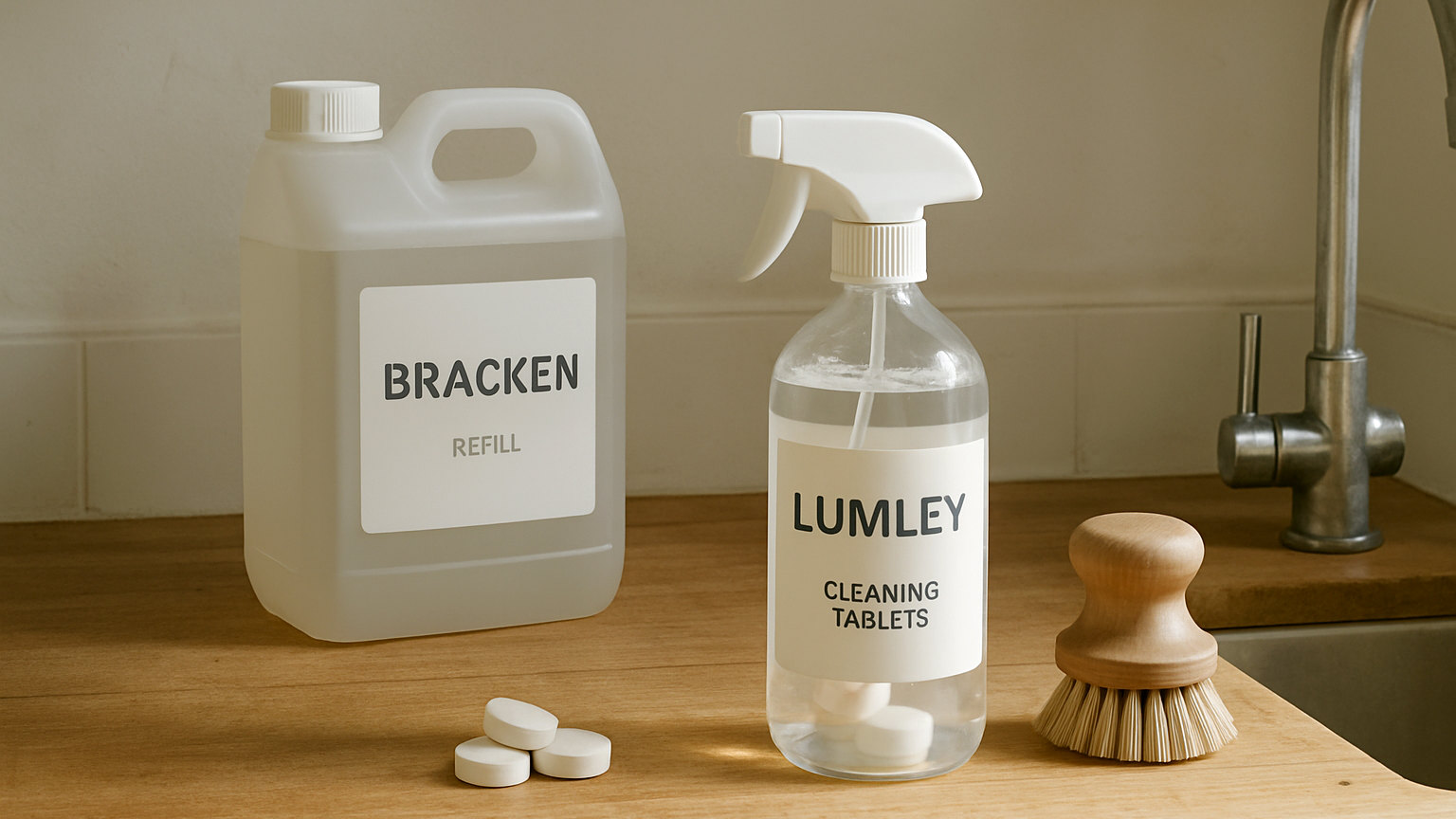
A concentrate or a refill tablet removes the water, the weight and most of the packaging in one step. That is usually a larger improvement than switching to a differently formulated liquid in the same bottle.
What about the use phase?
For laundry and dishwashing, the electricity used to heat the water outweighs the product impact considerably. Washing at a lower temperature and running full loads does more than changing detergent.
For surface cleaning the use phase is negligible, which shifts the balance back to packaging and ingredients.
What is the simplest genuine improvement?
Using less. Most households overdose detergent and cleaning sprays substantially, and the excess goes down the drain having done nothing. Halving the dose halves the impact and usually improves the result.
Buying fewer products, in larger quantities, with less packaging, follows from the same principle.
How do you judge a specific product?
- Look for a recognised certification rather than a self declared claim.
- Check whether it is a concentrate or a refill format.
- Read the ingredients list rather than the front of the bottle.
- Check the packaging material and whether it can be recycled locally.
- Consider whether you need the product at all.
What is the honest summary?
The most environmentally useful things in household cleaning are using less, buying concentrates and refills, choosing durable tools over disposable ones, and washing at lower temperatures. Product formulation matters and sits behind all of those.
Does buying fewer products help more than buying better ones?
Usually, yes. A cupboard of twenty products has twenty bottles, twenty transport journeys and a great deal of unused liquid that eventually goes down a drain. Six products used properly covers almost all household cleaning, and the reduction in packaging and waste outweighs the difference between one formulation and another.