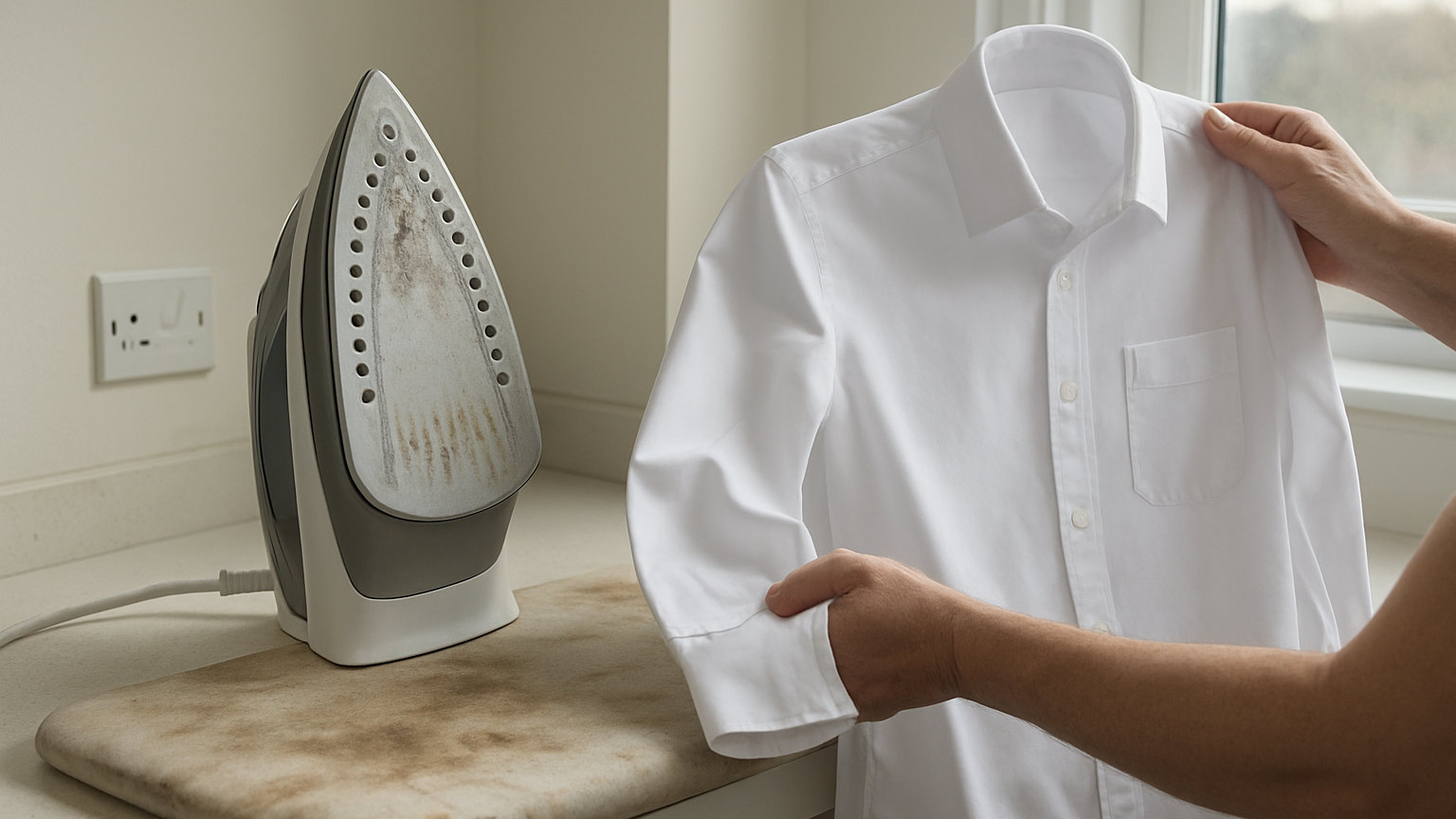
The traditional advice was to fill a steam iron with distilled water to prevent limescale. For many modern irons that advice is now wrong, and following it can cause spitting and leaking. The manufacturer instructions for your specific model are the authority, and they vary more than people expect.
Why did distilled water become the standard advice?
Because limescale is formed when the calcium and magnesium dissolved in hard water are left behind as the water boils. Remove the minerals and no scale can form, which is straightforward chemistry and was sound advice for older irons with simple steam chambers.
The problem is that modern irons are not simple steam chambers.
Why do some manufacturers now specify tap water?
Because their anti-scale systems and steam chambers are engineered around water containing some mineral content. Fully demineralised water can behave differently when it boils, producing larger irregular bubbles rather than fine steam, which causes spitting and spluttering in certain designs.
Some anti-calc cartridges are also designed to work with the minerals present, and pure water gives them nothing to act on.
The result is that a number of major brands now state tap water in the manual, sometimes with a note to mix it with distilled water in very hard water areas.
What should you actually use?
- Read the manual first. If it specifies tap water, use tap water.
- In a hard water area with an iron that permits it, a mix of roughly half tap and half distilled or filtered water is a sensible compromise.
- For a steam generator with a separate boiler, follow the instructions closely, since these are more sensitive and more expensive to replace.
- Jug filtered water is a reasonable general purpose choice, since it reduces hardness without removing everything.
What should never go in an iron?
- Water from a tumble dryer or dehumidifier tank, which is demineralised but carries lint, detergent residue and bacteria.
- Water from a water softener, which has exchanged calcium for sodium and can cause deposits and corrosion.
- Scented ironing water, unless the manufacturer explicitly allows it. Fragrance and additives clog the vents and can mark clothing.
- Rainwater, which carries particulates and biological contamination.
- Anything with vinegar or descaler left in it after cleaning, which must be fully flushed out.
How do you find out how hard your water is?
Your water supplier publishes hardness by postcode on their website, usually as a map or a lookup. It is worth checking, because the difference between a soft and a very hard supply changes how often the iron needs descaling and whether mixing water is worth the bother.
The practical test is how much scale appears in your kettle. A kettle that furs up within weeks means the iron will too.
Does using the right water remove the need to descale?
It slows it considerably but does not eliminate it, since residue from fabric conditioner and starch also accumulates inside the chamber. Run the self clean function every month or two regardless of what you fill the tank with.
What about emptying the tank?
Empty it after every ironing session without exception. Water left standing in a warm chamber accelerates scale formation considerably, and in a warm airing cupboard a tank of stagnant water can develop a smell of its own that transfers straight onto clean clothes the moment steam is used.
Unplug the iron and let it cool before emptying, tip it out through the fill hole, and store it upright.
What if the iron already spits?
Check the temperature setting first, since steam selected on a low setting produces water rather than vapour and is by far the most common explanation. If the setting is correct, run the self clean function and descale it properly. Only when both of those have been ruled out is the water type worth changing, and even then the manual should decide it rather than general advice.