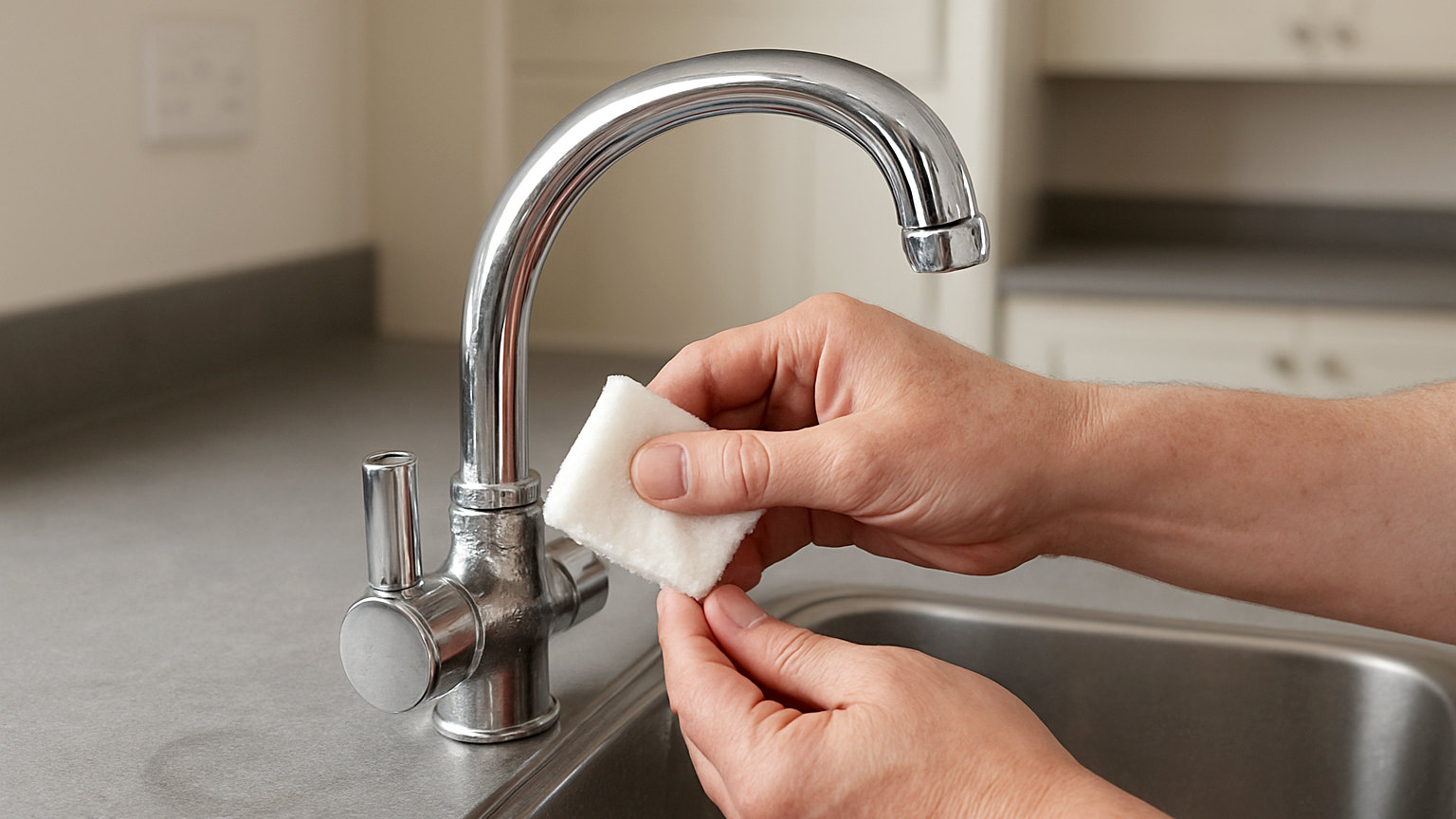
Limescale on taps is calcium carbonate deposited as water dries. Acid dissolves it easily, which is why vinegar and citric acid work. The complication is that the same acid attacks the finish on many taps, so the technique is about getting enough contact time on the scale and as little as possible on the tap.
What is the basic method?
- Soak a cloth or kitchen paper in white vinegar or a citric acid solution.
- Wrap it around the scaled area, pressing it into contact.
- Leave it for thirty minutes to an hour, re-wetting if it dries.
- Remove and work the softened scale with an old toothbrush.
- Rinse thoroughly with clean water.
- Dry and buff with a soft cloth.
Wrapping is the key. Wiping vinegar on and off achieves almost nothing on established scale, because the acid needs time in contact.
Which finishes are at risk?
- Chrome – generally tolerant of short acid contact, and dulls with prolonged exposure.
- Brushed and satin nickel – more vulnerable, and acid can leave patches.
- Brass, bronze and gold finishes – frequently a coating, which acid strips.
- Matt black – a powder or PVD coating that acid and abrasives both damage.
- Anything described as living finish – intended to age and easily marked.
For anything other than chrome, check the manufacturer guidance, keep contact time short, and test in a hidden spot underneath first.
What is the safer alternative?
A proprietary limescale remover formulated for bathroom and kitchen fittings, which is usually milder and often includes protection for the finish. Follow the stated contact time rather than leaving it longer.
For light deposits, a paste of bicarbonate of soda is gentle and works through mild abrasion rather than acid.
How do you clean the aerator?
The mesh at the tap outlet blocks with scale and causes a weak or spraying flow. On most taps it unscrews, either by hand or with a small spanner protected by a cloth.
Take it apart, noting the order of the parts, and soak everything in vinegar or citric acid for an hour. Brush the mesh clear, rinse and reassemble.
If it will not unscrew, fill a small bag with vinegar, tie it over the tap spout with an elastic band so the outlet is submerged, and leave it for an hour.
What about the base of the tap?
The joint where the tap meets the sink collects scale and grime and is awkward to reach. An old toothbrush with a little cream cleaner or bicarbonate paste works, and a vinegar soaked cloth wrapped around the base handles scale.
Dry that area afterwards, since standing water there is what causes the deposit in the first place.
What should never be used?
Wire wool, scouring pads and abrasive powders, which scratch every tap finish permanently. Bleach, which does nothing to limescale and can damage the finish. And any combination of bleach with an acidic descaler, which releases chlorine gas.
How do you prevent it?
Dry the taps after use, which is the only genuinely effective prevention. A quick wipe with a cloth or a towel after washing up stops the deposit forming at all.
In a very hard water area, a water softener addresses it throughout the house, and it is a significant investment justified by the effect on appliances as much as on taps.
What if the scale has been there for years?
Repeat the wrapping treatment over several sessions rather than escalating to something stronger. Thick scale softens in layers, and three one hour treatments achieve more than one aggressive attempt with an abrasive that ruins the finish.
What about the underside and the handles?
Scale builds under the spout and around the base of lever handles, where water runs and sits. Those areas need a wrapped cloth as much as the visible surfaces do, and an old toothbrush to work into the joint afterwards. A tap that looks clean from above is frequently scaled underneath.