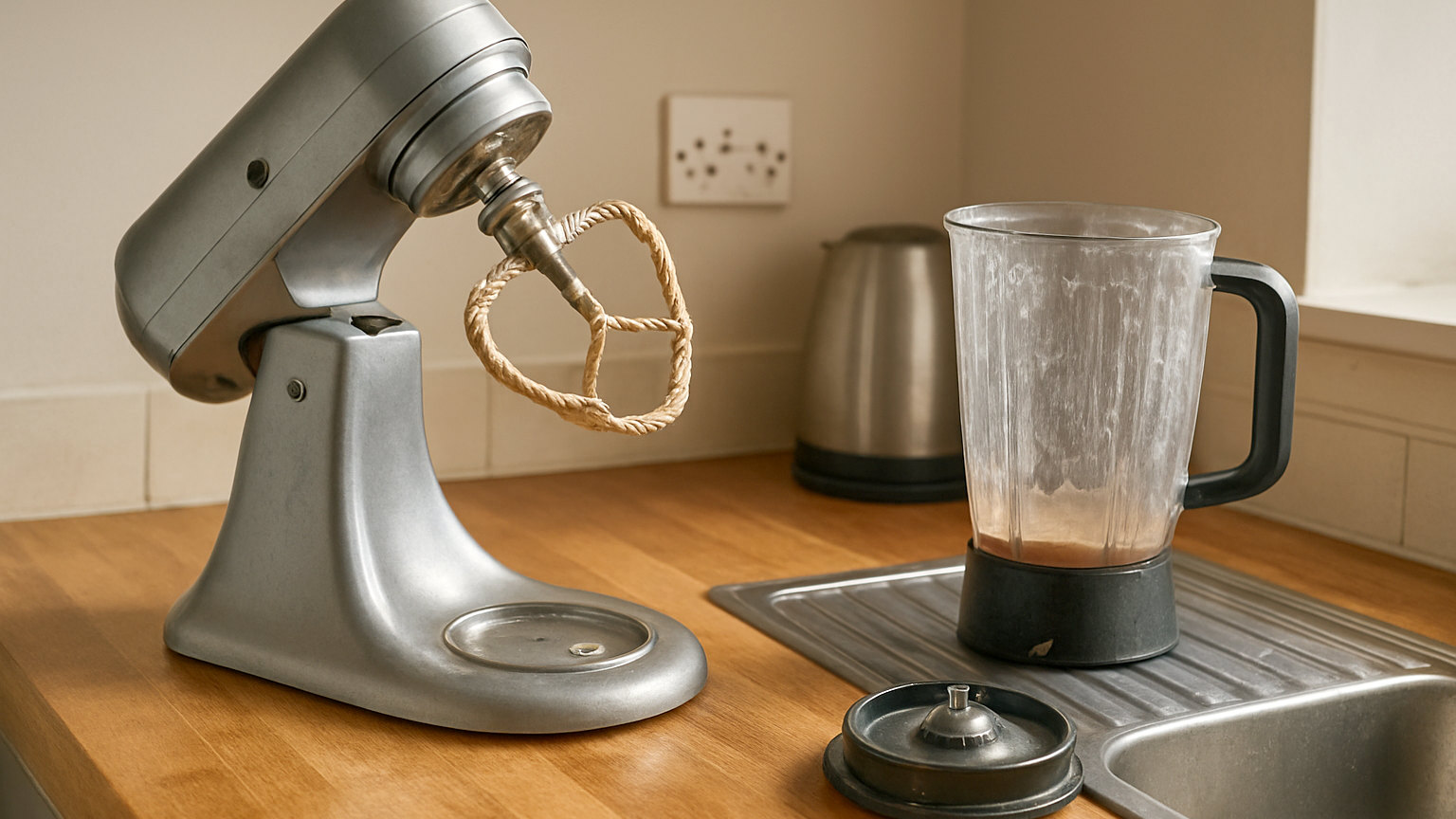
A stand mixer is simple to clean and has two areas that get overlooked: the shaft the beater attaches to, and the underside of the mixer head where batter is flung upwards during mixing. Both accumulate a hard residue over time.
What is the routine after each use?
- Unplug the mixer.
- Remove the bowl, the beater and any guard.
- Wash the bowl, beater and guard in hot soapy water.
- Wipe the beater shaft and the hub above it with a damp cloth.
- Wipe the underside of the head, the body and the base.
- Dry everything before reassembling.
Why does the beater shaft matter?
Because batter runs up the beater during mixing and collects where it meets the shaft, then dries into a hard ring. It is directly above the bowl, so anything that flakes off later ends up in the next mix.
Wipe it after every use with a damp cloth, and use a cotton bud around the pin. A build up that has hardened needs a damp cloth held against it for a few minutes to soften rather than scraping.
What about the underside of the head?
The same problem on a larger scale, particularly with liquid batters and anything mixed at speed. Tip the head back if it lifts, and wipe the whole underside including the recess around the hub.
This is also where the attachment hub sits on many mixers, behind a cover at the front, which should be wiped occasionally.
Which attachments are dishwasher safe?
It depends on the material. Stainless steel bowls and beaters are usually dishwasher safe. Bare aluminium beaters, which are common on older mixers, must be washed by hand, since dishwasher detergent pits and darkens aluminium.
Coated beaters vary and are generally better by hand, since the coating chips. Glass and ceramic bowls are usually fine.
Check the manual, and where an item is unmarked and metallic, hand wash it.
What about the dough hook and whisk?
The balloon whisk is the fiddliest part. Wash it immediately, since egg and batter set hard between the wires, and use a brush to get between them. A soak in hot soapy water for ten minutes does most of the work.
Check the whisk for bent wires, which affect performance, and check nothing has come loose at the collar.
How do you clean the body?
A cloth wrung out in warm soapy water, then dry. Never immerse any part of the motor housing and never run it under a tap.
For a painted or enamelled finish, avoid abrasives and solvents, which mark it. Dried batter on the body softens with a damp cloth held against it.
What about the bowl?
Stainless steel bowls scratch with abrasive pads, which is cosmetic. More important is that any grease residue in a bowl prevents egg whites whipping, so a bowl used for cake batter should be washed thoroughly and dried before meringue work.
A wipe with white vinegar or lemon juice before whipping egg whites removes any trace of fat.
What else is worth checking?
The clearance between the beater and the bowl, which is adjustable on most mixers and drifts over time. And any oil seepage around the head, which on older machines means the grease inside needs attention and is a service job rather than a cleaning one.
How do you clean the attachment hub?
The front hub, where a mincer or pasta roller attaches, sits behind a hinged cover and collects dust and splatter. Open it occasionally and wipe inside with a dry cloth, since it is a mechanical coupling rather than something that should be washed. Any attachment used in it should be cleaned separately according to its own instructions.
What about the splash guard?
The clear plastic guard is the part most likely to be neglected, because it is awkward to store and easy to leave off. Wash it by hand in warm soapy water rather than in a dishwasher, where it crazes and goes cloudy, and dry it before storing.