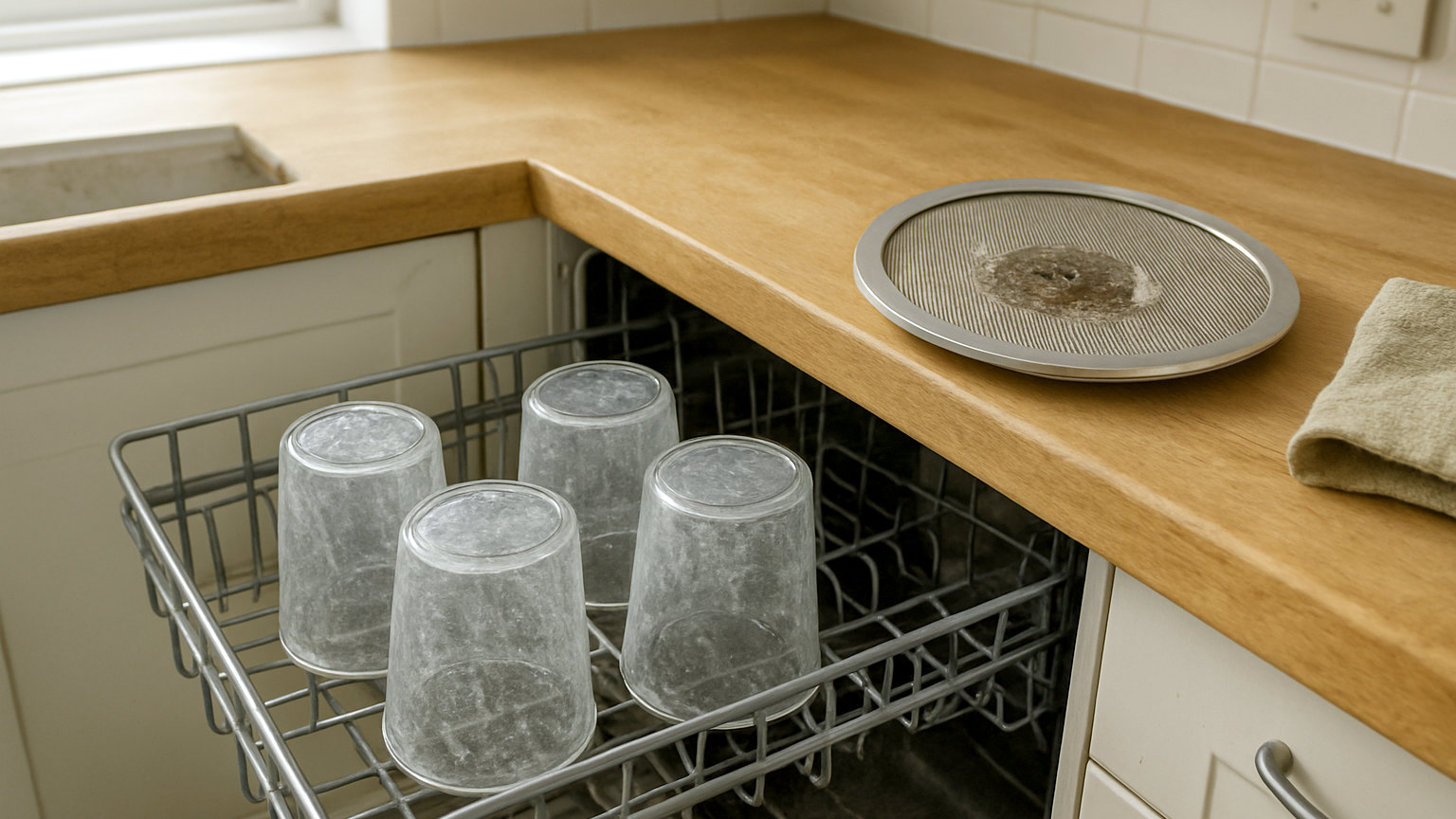
Cloudy glasses from a dishwasher have two possible causes and they are completely different. One is a deposit sitting on the surface, which comes off. The other is permanent damage to the glass itself, which does not. Telling them apart takes five minutes.
What is the test?
Soak the glass in white vinegar for fifteen minutes, or wipe it with a cloth soaked in vinegar, then rinse and dry.
If the cloudiness disappears, it is limescale or detergent film and it is fixable. If it remains, the glass has been etched and nothing will restore it.
What causes the limescale film?
Hard water. Minerals in the water deposit on the glass as it dries, building a film over repeated cycles. It affects everything in the machine and shows most on clear glass.
The fixes are dishwasher salt, which softens the water in the machine, and rinse aid, which helps water sheet off rather than forming droplets that dry into spots. In a hard water area both are needed, not one or the other.
What causes etching?
The opposite problem: water that is too soft, combined with detergent that is too aggressive, too hot a cycle, or too much detergent. Under those conditions the detergent slowly dissolves the surface of the glass.
It develops gradually over many cycles and appears as a permanent milky haze, sometimes with a rainbow sheen. It cannot be reversed.
How do you prevent etching?
- Use less detergent, particularly in a soft water area.
- Do not add dishwasher salt if your water is already soft, and set the machine water hardness correctly.
- Use a lower temperature programme for glassware.
- Use a glass or delicate programme if the machine has one.
- Wash delicate and older glass by hand.
Thin, older and hand blown glass etches far more readily than modern toughened glassware.
What is the machine hardness setting?
Most dishwashers have a setting that controls how much salt is released, and it should match the hardness of your local water. Your water supplier publishes that figure by postcode.
Set too low in a hard area and you get limescale film. Set too high in a soft area and you contribute to etching. It is worth finding in the manual and setting correctly, since most machines are left on the factory default.
Do all in one tablets cover it?
They include rinse aid and water softening agents, and in moderately hard water they are usually adequate. In very hard water, separate dishwasher salt is still recommended, because the softening component in a tablet is limited.
If glasses are filming despite using all in one tablets, add salt and check the hardness setting.
What about a white film on everything?
If plastic, cutlery and the interior are all filmed, that is limescale rather than etching, and it means the salt reservoir is empty or the hardness setting is wrong. Run a descaling cycle with citric acid, then fix the salt and the setting.
Can etched glass be rescued?
No. The surface has been dissolved and there is nothing to remove. Polishing compounds will not restore it and may make it worse.
The realistic response is to prevent it happening to the rest: reduce the detergent, correct the hardness setting, use a cooler programme, and wash anything valuable by hand.
Why does it only affect some glasses?
Because glass composition varies considerably. Thin, older and hand blown glass etches far more readily than modern toughened glassware, and lead crystal is the most vulnerable of all. A set of everyday tumblers can go through years of cycles unaffected while a set of wine glasses clouds within months in the same machine.
What about plastic and cutlery?
A white film on plastic, cutlery and the tub walls together is limescale rather than etching, and it responds to a citric acid cycle followed by fixing the salt and hardness setting. Cutlery that comes out spotted rather than filmed usually means the rinse aid is empty or set too low.