A dishwasher handles hot water and detergent constantly and still accumulates grease, food debris and limescale. The build up happens in the filter, the spray arms, the door seal and the drain, none of which are scoured by the wash the way the dishes are.
What are the parts that matter?
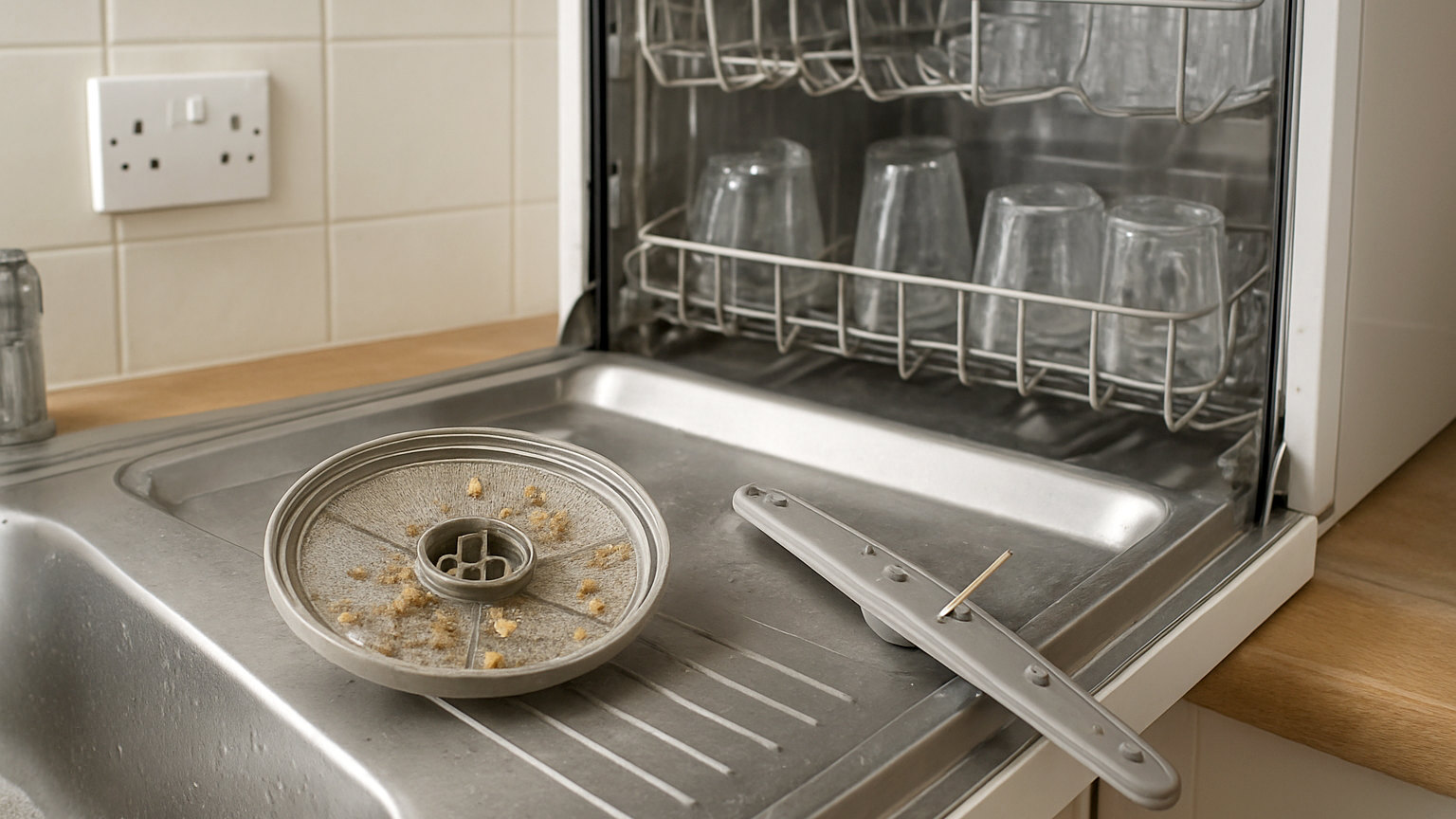
- The filter at the bottom of the tub, which catches food debris.
- The spray arms, whose jets block with scale and seeds.
- The door seal, particularly the bottom edge and the corners.
- The area below the door, outside the seal, which is never washed.
- The detergent dispenser and the rinse aid cap.
What is the full routine?
- Pull out the bottom rack and lift out the filter assembly.
- Rinse the filter under a hot tap and scrub it with a washing up brush.
- Wipe out the sump underneath where the filter sits.
- Unclip the spray arms and clear the jets with a cocktail stick.
- Wipe the door seal, working into the folds and the corners.
- Wipe the lip below the door, outside the seal, which collects grease.
- Refit everything and run an empty hot cycle with a dishwasher cleaner or white vinegar.
What should go in the empty cycle?
A proprietary dishwasher cleaner, or a cup of white vinegar in a bowl on the top rack, or around 100g of citric acid in the detergent compartment. Run the hottest programme available with nothing else in the machine.
Vinegar and citric acid both address limescale as well as grease, which makes them the better choice in a hard water area.
Why does the filter matter so much?
Because it is where everything the machine removes from the dishes ends up. A blocked filter means water cannot drain properly, dirty water recirculates over the load, and the debris sits there decomposing between cycles. It is the cause of most dishwasher smells and most complaints about dishes not coming out clean.
Most modern dishwashers have a manual filter that needs cleaning weekly or fortnightly. Older machines sometimes have a self cleaning grinder instead, which is noisier and needs less attention.
How often should each job be done?
- Filter – weekly, or fortnightly for light use.
- Door seal and door lip – weekly.
- Spray arms – every couple of months, or when cleaning performance drops.
- Empty hot cycle with a cleaner – monthly.
- Descale – every three months in a hard water area.
What gets missed?
The lip below the door, outside the seal, which is not reached by any cycle and collects a black greasy deposit. The corners of the door seal. The cutlery basket, which is rarely taken out and washed. And the rinse aid and salt caps, where residue builds around the thread.
What should you avoid?
Bleach in a dishwasher, which damages seals and can react badly with detergent residue, and should never be used in a machine with a stainless steel interior. Abrasives on the interior. And washing up liquid, which produces enormous quantities of foam and will flood the kitchen floor.
Does leaving the door open help?
Considerably. A dishwasher closed after a cycle stays damp inside, which is the condition that produces the smell. Leaving the door ajar between cycles lets it dry, and it is the simplest preventative measure available.
Where a child or pet could reach it, leave it open only while the kitchen is occupied.
What about the interior surfaces?
Stainless steel tubs benefit from an occasional wipe with a damp cloth and a stainless steel cleaner, worked in the direction of the grain. Plastic tubs stain over time, particularly with turmeric and tomato, and a citric acid cycle lightens the marks considerably. Neither should meet an abrasive, which scratches the surface and gives residue somewhere to lodge.
How long does the whole routine take?
About ten minutes of hands on work once a month, plus the cycle running in the background. The filter alone is two minutes weekly. Set against the cost of an engineer visit for a blocked pump, it is one of the better returns on effort in a kitchen.