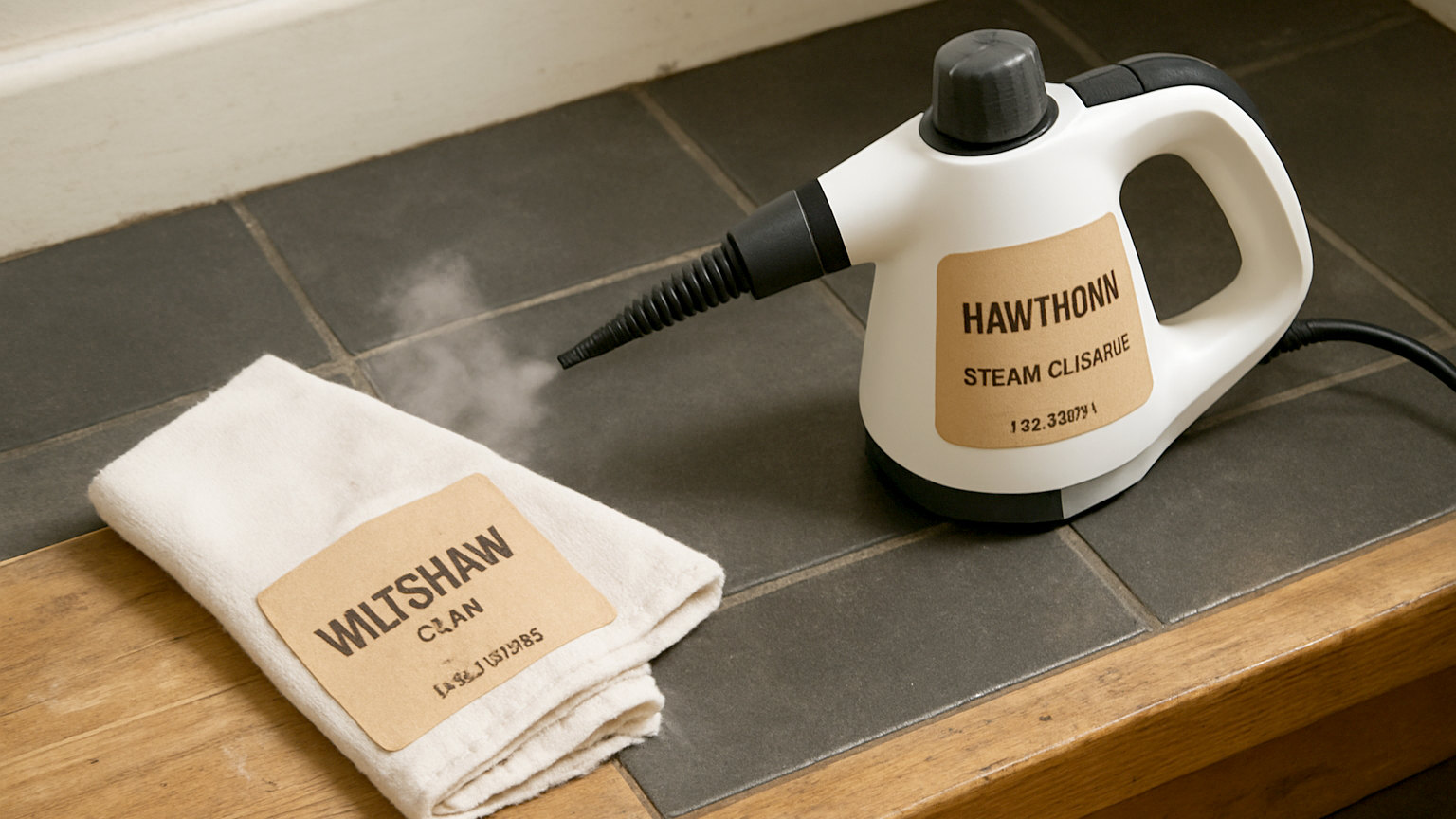
Steam cleans glass very well. The heat softens grime, the moisture lifts it and a squeegee attachment clears it in one pass, which produces a streak free finish with no chemicals. The one thing to be careful of is applying hot steam to cold glass.
What is the thermal shock risk?
Glass expands when heated, and if one small area is heated rapidly while the surrounding glass stays cold, the stress can crack it. That is a genuine risk on a cold window in winter rather than a theoretical one.
Warm the pane gradually. Start with the nozzle well back, perhaps thirty centimetres, and move closer over several passes. Work across the whole pane rather than concentrating on one spot.
Avoid steaming windows on a very cold day, and never steam glass that is already cracked or chipped.
What about double glazing?
Sealed units are generally fine with the gradual warming approach. A unit with a failed seal, which shows as misting between the panes, should not be steamed, since it already has moisture inside and heat may make it worse.
Keep the steam away from the sealant and the frame joints where possible.
What is the method?
- Fit the window squeegee attachment with its cloth cover.
- Warm the glass gradually from a distance.
- Steam a section from top to bottom, working close enough to soften the grime.
- Pull the squeegee down in a single continuous stroke.
- Wipe the blade with a cloth after every stroke.
- Overlap each stroke slightly with the last.
- Dry the edges, the sill and the frame with a cloth.
Why wipe the blade between strokes?
Because the blade carries the dirt it has just collected, and leaving it there deposits a line on the next stroke. It is the same principle as with a conventional squeegee and it is what separates a clean result from a streaky one.
What about the tracks and frames?
This is where steam genuinely outperforms everything else. Window tracks and runners collect compacted grime that is very difficult to reach with a cloth, and a detail nozzle blasts it out in seconds.
Vacuum the loose debris first, then steam along the track, then wipe with a cloth wrapped around a thin tool. Repeat on the drainage holes at the bottom of the frame, which block and cause condensation problems.
What about uPVC frames?
They tolerate steam well and it lifts the greyish film that builds on white uPVC. Keep the nozzle moving and do not hold it against the plastic, which can mark.
Avoid steaming the rubber seals directly, since prolonged heat degrades them.
What about mirrors?
Steam works and the backing is the concern. Moisture reaching the silvered back edge of a mirror causes black spotting that cannot be repaired.
Keep the steam away from the edges entirely, work from the centre outwards, and dry the edges immediately. For an old or valuable mirror, a damp cloth is the safer choice.
What about shower screens?
Good for soap scum and general film, and it does not remove limescale, which is a mineral deposit needing acid. Steam softens it, which makes a subsequent acidic treatment work faster.
The usual sequence is steam, wipe, then a vinegar or citric acid treatment on any remaining scale.
Is it better than the two cloth method?
For heavily soiled windows and for tracks, yes. For a lightly dusty mirror or a clean pane, a damp microfibre cloth followed by a dry flat weave cloth is quicker and needs nothing to be heated.
The steam advantage is on grime rather than on dust.
What about condensation afterwards?
Steaming windows puts moisture into a cold room, which then condenses on the glass you have just cleaned. Open a window or run an extractor while working, and dry the sills and frames properly.
When is the best time to do it?
A mild, dry, overcast day. Cold glass carries the thermal shock risk, and direct sunlight dries the glass before the squeegee reaches it, which causes streaking. An overcast day in spring or autumn is close to ideal, and a frosty morning is the worst possible choice.