Homemade glass cleaner works very well, because glass needs almost nothing done to it. Streaking is caused by residue left behind rather than by dirt not being removed, so the best formulation is the one that evaporates cleanly and leaves nothing.
What is the basic recipe?
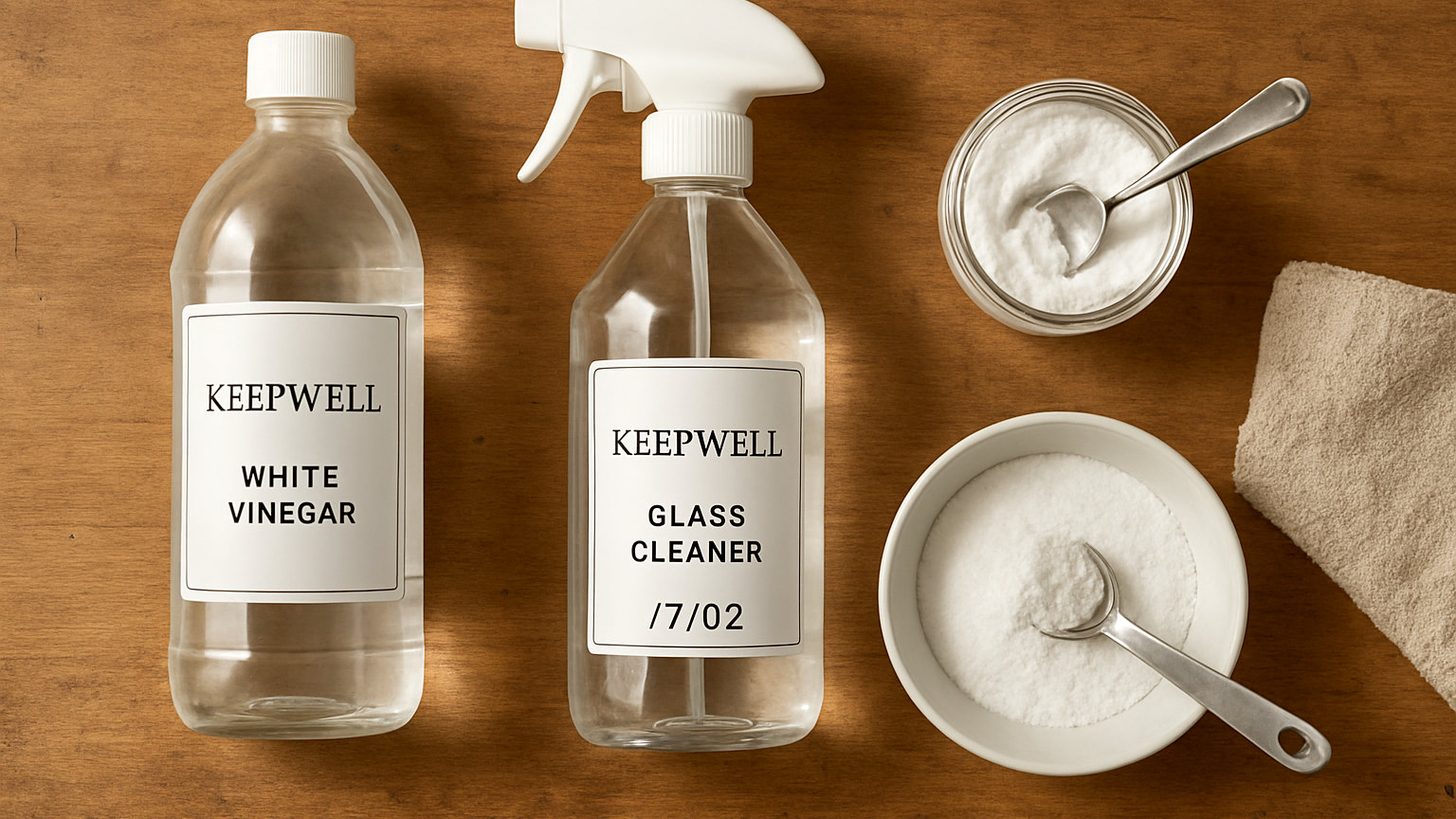
- Take a clean 500ml spray bottle.
- Add 250ml of white vinegar.
- Add 250ml of water, ideally distilled in a hard water area.
- Add one or two drops of washing up liquid, no more.
- Label it and use within a couple of months.
The vinegar cuts limescale and film, the tiny amount of detergent lifts grease, and the water carries it. More detergent makes it streak.
What is the faster drying version?
Replace half the water with surgical spirit. Roughly one part vinegar, one part surgical spirit and two parts water gives a cleaner that evaporates quickly, which reduces streaking considerably and helps in cold weather.
Keep it away from flames, label it clearly, and do not use it on tinted or coated glass without testing.
Why does distilled water help?
Because in a hard water area the minerals in tap water dry on the glass as a film, which is the very thing you are trying to remove. Distilled or filtered water leaves nothing behind.
In a soft water area tap water is fine.
Does the cloth matter more than the liquid?
Considerably. A flat weave glass cloth or a waffle weave microfibre gives a streak free finish with almost any liquid, and a general purpose cloth with a longer pile will streak with the best cleaner available.
The two cloth method is the reliable one: a damp cloth to clean, then a dry flat weave cloth to buff. Most streaking problems are solved by that alone.
What about newspaper?
The traditional method, and it worked better with the papers and inks of the past. Modern newsprint is thinner and the soy based inks transfer differently, so results vary and some people find it leaves marks.
A good microfibre glass cloth outperforms it and is washable.
Where should it not be used?
- Tinted or coated glass, where vinegar can damage the coating.
- Car windscreens with a rain repellent treatment.
- Screens of any kind, including televisions, monitors and phones.
- The edges of mirrors, where liquid reaching the backing causes black spotting.
- Natural stone surrounds near the glass, which vinegar etches.
How do you clean a screen instead?
A dry microfibre cloth for dust, and for marks a cloth very lightly dampened with plain distilled water. Nothing containing vinegar, alcohol or ammonia, all of which damage the anti-glare and oleophobic coatings.
Spray the cloth, never the screen.
What is the best technique?
Work in one direction on one side of the glass and the other direction on the reverse, which tells you which side any remaining streak is on. Clean the frame and the sill first so nothing drips onto clean glass.
Avoid direct sunlight, which dries the liquid before you can buff it and guarantees streaking.
Does the smell go?
Yes, within a few minutes as the vinegar evaporates. Adding citrus peel to a jar of vinegar for a fortnight makes it more pleasant to use and changes nothing about how it works.
Is it as good as a branded glass cleaner?
Yes, for domestic use. Most commercial glass cleaners are water, a solvent such as alcohol, a trace of surfactant and a fragrance, often with ammonia. The homemade version is the same idea without the ammonia, which matters if any bleach product is used in the same room.
What about outdoor windows?
The same solution works and the quantity needed is greater, so a bucket with a squirt of washing up liquid and a splash of vinegar is more practical than a spray bottle. Use a squeegee rather than cloths on anything large, wiping the blade after every stroke, and avoid working in direct sun.