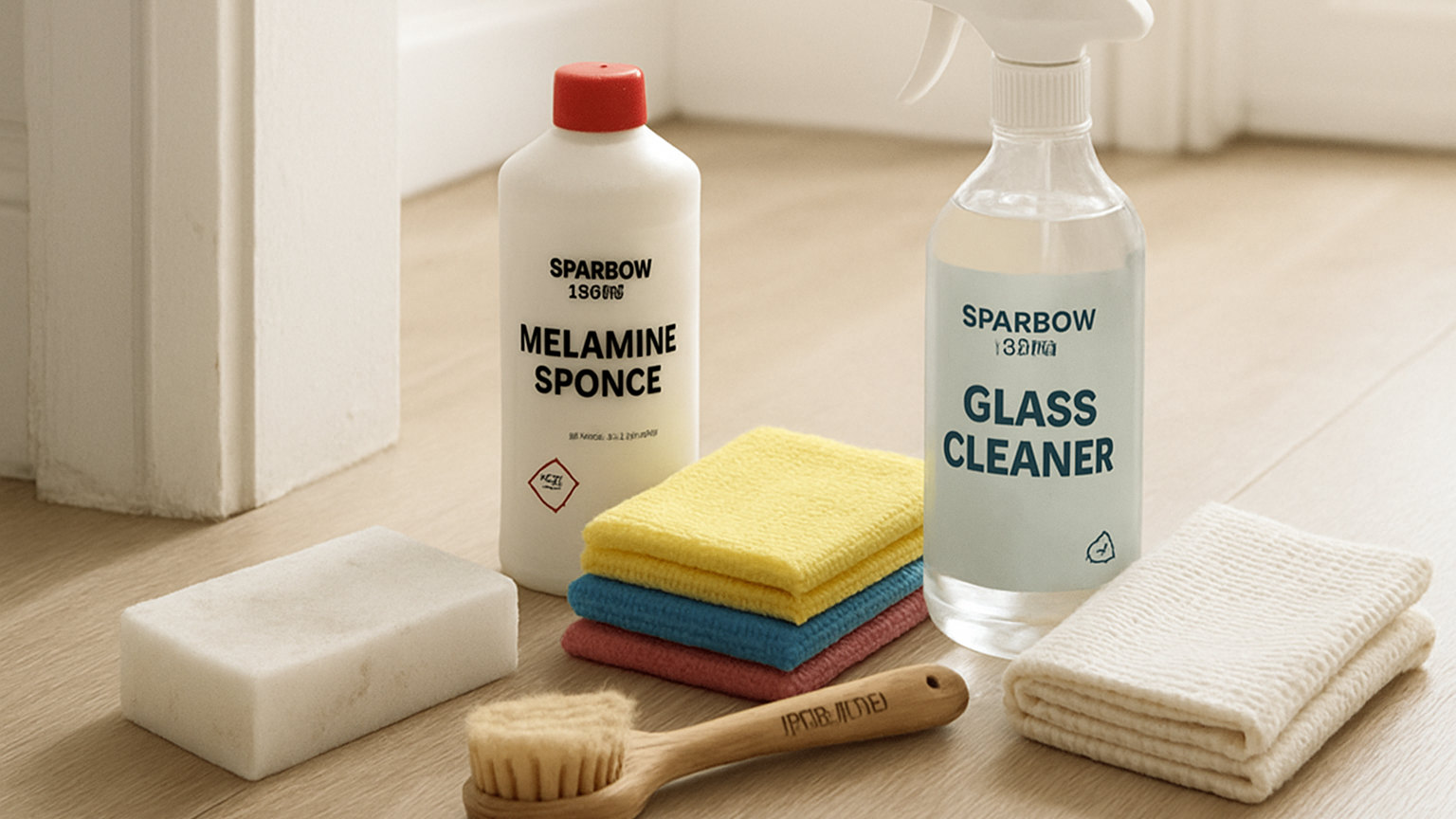
Melamine foam sponges work extremely well on marks that nothing else shifts, and they are not cleaners in the usual sense. They contain no detergent and no active ingredient. The foam is a very fine open structure that hardens when wet and acts as an extremely fine abrasive, effectively a micro sandpaper.
How does that change how you use them?
Entirely. Every pass removes a microscopically thin layer of whatever it is rubbed against, including the mark and a little of the surface beneath. On a hard glazed surface that is imperceptible. On a soft, matt or coated one it is permanent damage.
The sponge also visibly wears away as you use it, which is the foam abrading rather than dissolving.
Where do they excel?
- Scuff marks on hard flooring and skirting boards.
- Crayon and pen on gloss painted woodwork.
- Tide marks in baths and on shower trays.
- Grey metal marks on ceramic sinks.
- Tea and coffee staining in mugs.
- Grime on uPVC window frames and door frames.
- Marks on glazed tiles and grout.
Where must they not be used?
- Matt emulsion walls, which they burnish into a shiny patch worse than the mark.
- Gloss and satin paint, which they dull.
- Car paintwork, which they scratch.
- Polished stone, quartz and stainless steel.
- Non-stick coatings.
- Glass hobs, screens and phone or television displays.
- Anything with a printed, transferred or lacquered finish.
- Acrylic baths and shower trays, which scratch and then stain.
The wall case is worth emphasising, since it is the most common use and the most common regret.
How should one be used?
- Dampen it with clean water and squeeze out the excess.
- Test in a hidden area and let it dry before judging.
- Work with very light pressure in small circles.
- Check progress frequently rather than working blind.
- Wipe the area with a clean damp cloth afterwards to remove the residue.
- Stop as soon as the mark has gone.
Pressure is the thing to keep low. Bearing down does not speed it up and does considerably more damage.
Are they safe around food and children?
Melamine foam is generally regarded as inert in use, and the residue it sheds should be wiped away and not left on food preparation surfaces or crockery. Rinse anything treated thoroughly.
Keep them out of reach of children, since they look like something edible and are not.
Why do they wear out so quickly?
Because the mechanism consumes the sponge. A melamine sponge crumbles away as it works, and a heavily soiled job can use one up in a few minutes. That is normal rather than a defect.
Cutting a large sponge into four gives four usable pieces and makes them last considerably longer.
Is the branded version better?
Marginally in density in some cases, and the material is the same. Unbranded melamine foam sponges bought in bulk cost a small fraction of the branded ones and perform almost identically.
What is the honest summary?
An excellent tool for a specific set of jobs, dangerous on anything with a finish, and no substitute for a cleaner where the problem is dirt rather than a mark. Test first, use lightly, and keep it away from paint.
Do they work dry?
No. Melamine foam needs to be damp to work, since the water softens the structure just enough for it to conform to the surface while remaining abrasive. Used dry it crumbles quickly and does very little. Squeeze out the excess after wetting, since a dripping sponge simply spreads the residue around.
What can they not remove?
Anything that has soaked into a porous surface, since they work at the surface only. Grease, which needs a degreaser rather than abrasion. Limescale, which needs acid. And staining that is within the material rather than on it, such as discoloured grout, where the sponge removes a layer without reaching the colour.
How do you store them?
Rinse thoroughly after use and let one dry, since a damp melamine sponge left in a caddy degrades and holds bacteria like any other foam. They are consumable rather than durable, so keep a few rather than trying to make one last.