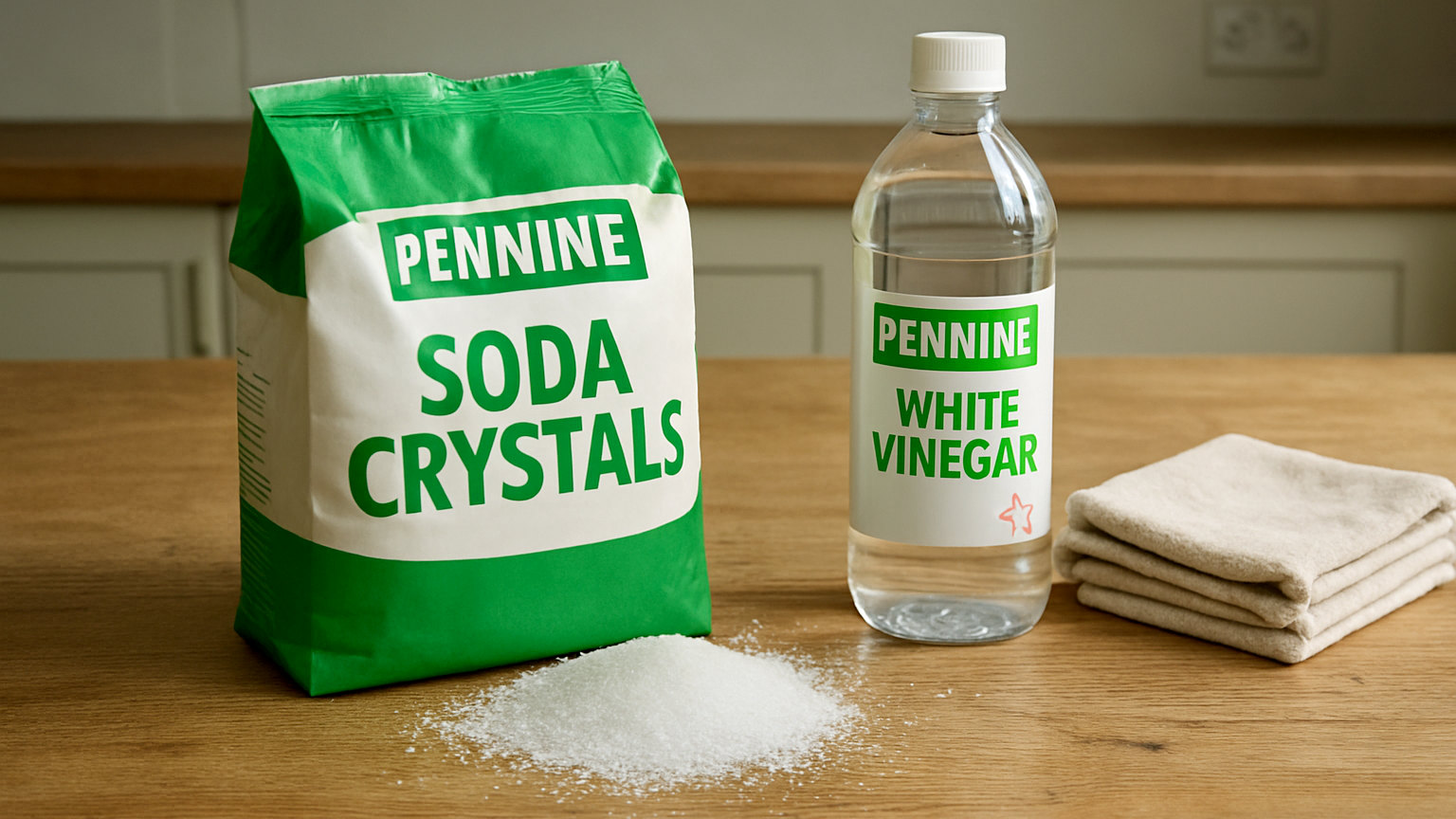
Soda crystals are sodium carbonate, also sold as washing soda. They are strongly alkaline at around pH 11, which makes them far more effective on grease than bicarbonate of soda, and they cost very little. They are the most useful product that most households do not have.
What are they good for?
- Cutting grease on hobs, extractor filters, oven shelves and grill pans.
- Clearing slow drains, a handful followed by very hot water.
- Soaking oven shelves and baking trays overnight.
- Degreasing kitchen cloths and tea towels in a hot soak.
- Boosting laundry, particularly in hard water areas.
- Cleaning patios, paths and outdoor bins.
- Stripping old polish from hard floors.
How do they work on grease?
Through saponification. A strong alkali reacts with fat and converts it into a soap, which is water soluble and rinses away. That is a chemical conversion rather than a lifting action, which is why it works on baked on deposits that detergent cannot shift.
It needs heat and time. Hot water and an overnight soak achieve far more than warm water and an hour.
How do you use them?
- Dissolve them in hot water rather than sprinkling them dry.
- Use roughly a handful to a washing up bowl, or a cup to a bath for soaking shelves.
- Leave items to soak for several hours or overnight.
- Wear gloves, since the solution is drying and irritating to skin.
- Rinse thoroughly afterwards.
How do they compare with bicarbonate?
Chemically similar and practically very different. Bicarbonate is sodium bicarbonate at around pH 8, mild and safe on most surfaces. Soda crystals are sodium carbonate at around pH 11, considerably stronger and more restricted in where they can be used.
For a greasy oven shelf, soda crystals work and bicarbonate largely does not. For a gentle scouring paste on a sink, bicarbonate is right and soda crystals are too harsh.
Where must they not be used?
- Aluminium, which they attack, discolour and pit.
- Wool and silk, which are protein fibres damaged by strong alkali.
- Anything with elastane, which degrades.
- Natural stone, particularly polished marble and limestone.
- Lacquered and painted surfaces without testing.
- Bare skin, so wear gloves.
The aluminium warning matters, because a great many baking trays, oven shelves and pans are aluminium.
Are they good for drains?
Very. A generous handful followed by a kettle of very hot water, left for thirty minutes or overnight, clears a great deal of the congealed fat that causes kitchen blockages. It is cheaper and far kinder to pipes than caustic drain cleaner.
As a monthly maintenance habit it prevents most blockages from forming at all.
What about in the washing machine?
Added to a wash they soften the water, which lets detergent work better and reduces limescale build up in the machine. They also help on greasy work clothes and kitchen textiles.
Keep them out of any wash containing wool, silk or elastane.
Where do you buy them?
Supermarkets and hardware shops, usually in a large bag at a very low price. They should be kept dry and sealed, since they absorb moisture from the air and clump into a solid block, which still works and is harder to measure.
Are they the same as caustic soda?
No, and the distinction matters. Caustic soda is sodium hydroxide, far stronger and genuinely dangerous to handle, used in drain cleaners and oven cleaners. Soda crystals are sodium carbonate, much milder, and safe to use with gloves in a domestic setting. The two are sometimes confused because both are described as washing soda in older sources.
What about the dishwasher and the toilet?
A handful in an empty dishwasher on a hot cycle cuts grease in the machine, and they work well down a toilet as a general cleaner where a limescale product is not needed. They are also effective on outdoor bins, which is one of the more unpleasant jobs they make considerably easier.