A towel that has stopped absorbing has not worn out. Something is coating the fibres and repelling water, and in almost every case it is fabric conditioner, excess detergent or hard water minerals. All three are reversible, and once the coating is gone the towel usually performs like new.
Why does fabric conditioner ruin towels?
Because it works by depositing a thin waxy layer on the fibres to make them feel smooth. That layer is water repellent by nature, which is the exact opposite of what a towel needs to do. The towel feels soft and plush while drying almost nothing, which is why people often describe new towels as absorbent and the same towels six months later as useless.
The effect accumulates. A few washes make little difference; a year of conditioner on every load makes a towel functionally waterproof.
What is the right way to wash them?
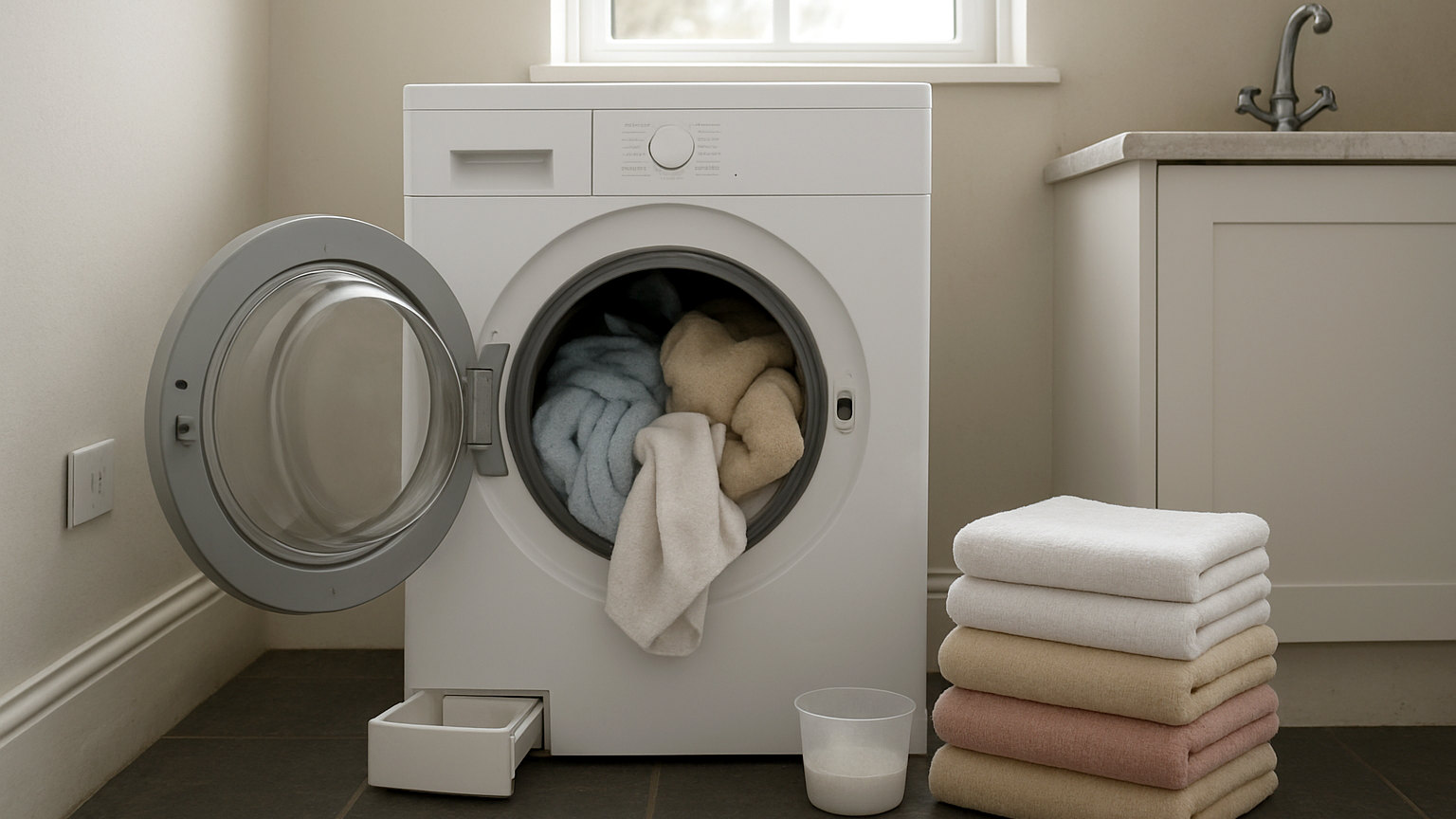
- Wash towels separately from clothing, since they shed lint heavily and need a different cycle.
- Use a cotton cycle at 40 degrees for routine washes, and 60 when they have been left damp or have started to smell.
- Use about two thirds of the usual detergent dose, and powder rather than liquid if the towels are white.
- Skip fabric conditioner entirely.
- Add an extra rinse if the machine offers one.
- Use a full spin, since towels hold a great deal of water.
- Do not overload. Towels expand enormously when wet and need room to move.
How do you strip an existing coating?
Run the towels through a hot wash with no detergent and no conditioner at all, followed by a second cycle with a cup of white vinegar in the drum. Vinegar dissolves both the softener residue and the mineral deposits from hard water. Then run a third cycle with a small amount of detergent to remove the vinegar.
Most towels recover noticeably after one round of this, and completely after two. It is worth doing before replacing towels that seem to have failed.
What does bicarbonate of soda do?
Half a cup added to the drum helps lift residue and neutralise odour, and it is a reasonable addition to a stripping wash. It is not necessary in routine washing, where reducing the detergent dose achieves the same thing more simply.
Should towels be tumble dried?
A tumble dryer is genuinely better for towels than line drying, because the tumbling action lifts and separates the pile, which is what makes a towel feel soft. Line dried cotton in a hard water area dries flat and board-like as the fibres set in position.
Use a medium heat rather than high, since excessive heat damages the loops and makes the towel shed. Wool dryer balls speed drying and improve the result. Take towels out slightly before they are bone dry, as over-drying is hard on the fibres.
If you line dry, a ten minute tumble at the end restores most of the softness.
Why do new towels not absorb properly?
Because many are finished with a coating applied during manufacture to make them look glossy and full in the shop. Wash new towels before use, ideally twice, with a cup of white vinegar in the first wash. Absorbency improves considerably over the first few washes as the finish comes away.
How do you stop them smelling?
Dry them properly, every time. A damp towel folded onto a rail stays wet for hours and develops bacteria that produce the characteristic sour smell, which then reappears whenever the towel gets wet again. Hang towels spread out rather than folded, ventilate the bathroom, and give each person their own towel.
Once the smell has set in, a 60 degree wash with a cup of white vinegar and no conditioner usually clears it.
How often should they be washed?
Bath towels every three or four uses, hand towels every couple of days, and flannels after each use. Any towel that has been left damp needs washing regardless of how many times it has been used.