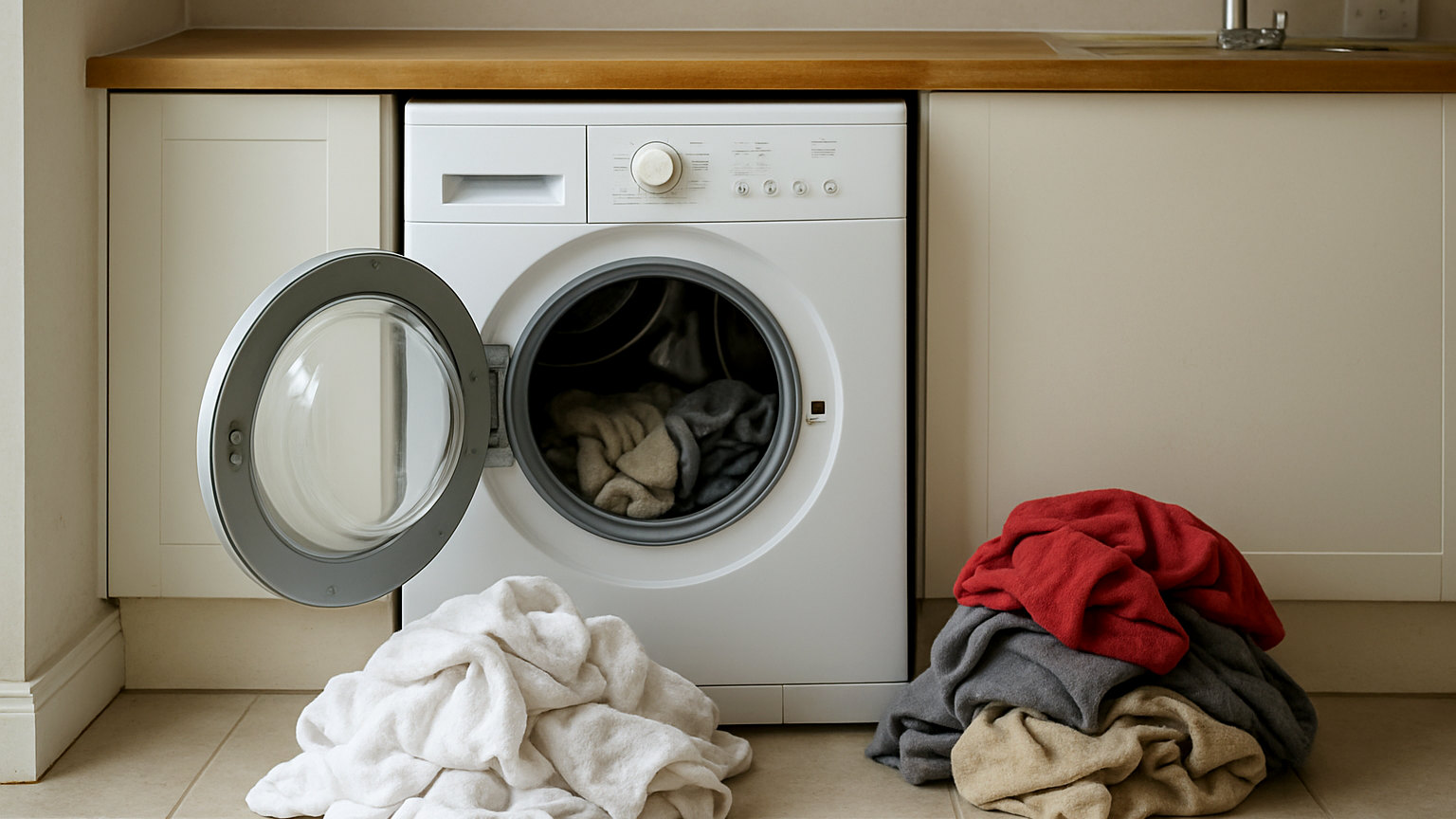
A washing machine cleans by moving clothes through detergent solution, so the fabric has to be free to tumble, lift and drop. A drum packed to the door does not clean, it merely gets wet, and overloading is probably the single most common reason a wash comes out looking no better than it went in.
How full is right?
The usual guide is that a cotton load should fill the drum with a hand span of space at the top – enough room to lay your hand flat between the clothes and the top of the drum. Synthetics want the drum about half full, and delicates about a third.
Those differences exist because the gentler cycles rely on more water and free movement rather than on mechanical action, so they need more space to work.
What happens when a machine is overloaded?
- Clothes do not get clean, because detergent solution cannot circulate through the compacted fabric.
- Rinsing is incomplete, leaving detergent residue that causes stiffness and skin irritation.
- Creasing is much worse, particularly on shirts and synthetics.
- The spin is compromised, because the machine cannot balance the load and reduces the speed to compensate.
- Wear increases, since fabric is dragged and rubbed against fabric rather than moving through water.
- The bearings and suspension take more strain, which shortens the life of the machine.
What about underloading?
Washing a handful of items in a large drum wastes water, energy and detergent, and can cause the machine to struggle with balance during the spin, since a small load ends up as a single wet lump on one side.
Modern machines with load sensing reduce water for part loads, which helps considerably. Even so, waiting for a fuller load is more efficient, and adding a few towels to bulk out a small wash is a reasonable compromise when something is needed urgently.
Does the stated capacity mean what it says?
It refers to the dry weight of cotton the machine is rated for, so an 8kg machine takes 8kg of dry cotton. It is not a measure of volume, which is why a duvet that weighs very little can still be too bulky to wash properly.
The capacity also assumes cotton on a cotton cycle. For synthetics and delicates the practical capacity is roughly half and a third of that figure respectively, and the manual will usually say so.
How do you estimate weight without scales?
Rough figures are useful. A bath towel is about 700g, a pair of jeans around 800g, a cotton shirt about 250g, a jumper roughly 400g and a double duvet cover around 900g. An 8kg machine therefore takes something like ten towels, or a mixed load of fifteen to twenty everyday garments.
In practice the hand span test is quicker and good enough.
Why does the machine bang and move during the spin?
Because the load is unbalanced. A single heavy item, particularly a towel or a duvet cover that has wrapped around itself, sits on one side of the drum and the machine cannot spin it evenly. Many machines will detect this, stop, redistribute and try again, which is why a wash sometimes takes far longer than the display suggested.
Mixing garment sizes in a load helps, since small items fill the gaps between large ones. Fastening duvet covers helps too, because an open cover acts like a bag and swallows everything else in the drum.
Should heavy items be washed alone?
Usually not. A single duvet, a rug or a large coat will unbalance the drum badly and may not get properly rinsed, because the water cannot circulate through a compressed mass of fabric. If the item is large enough that it cannot tumble freely with a little space around it, the machine is simply too small for it, and a launderette with a commercial drum is the better and often cheaper answer once the risk of ruining the item is taken into account.