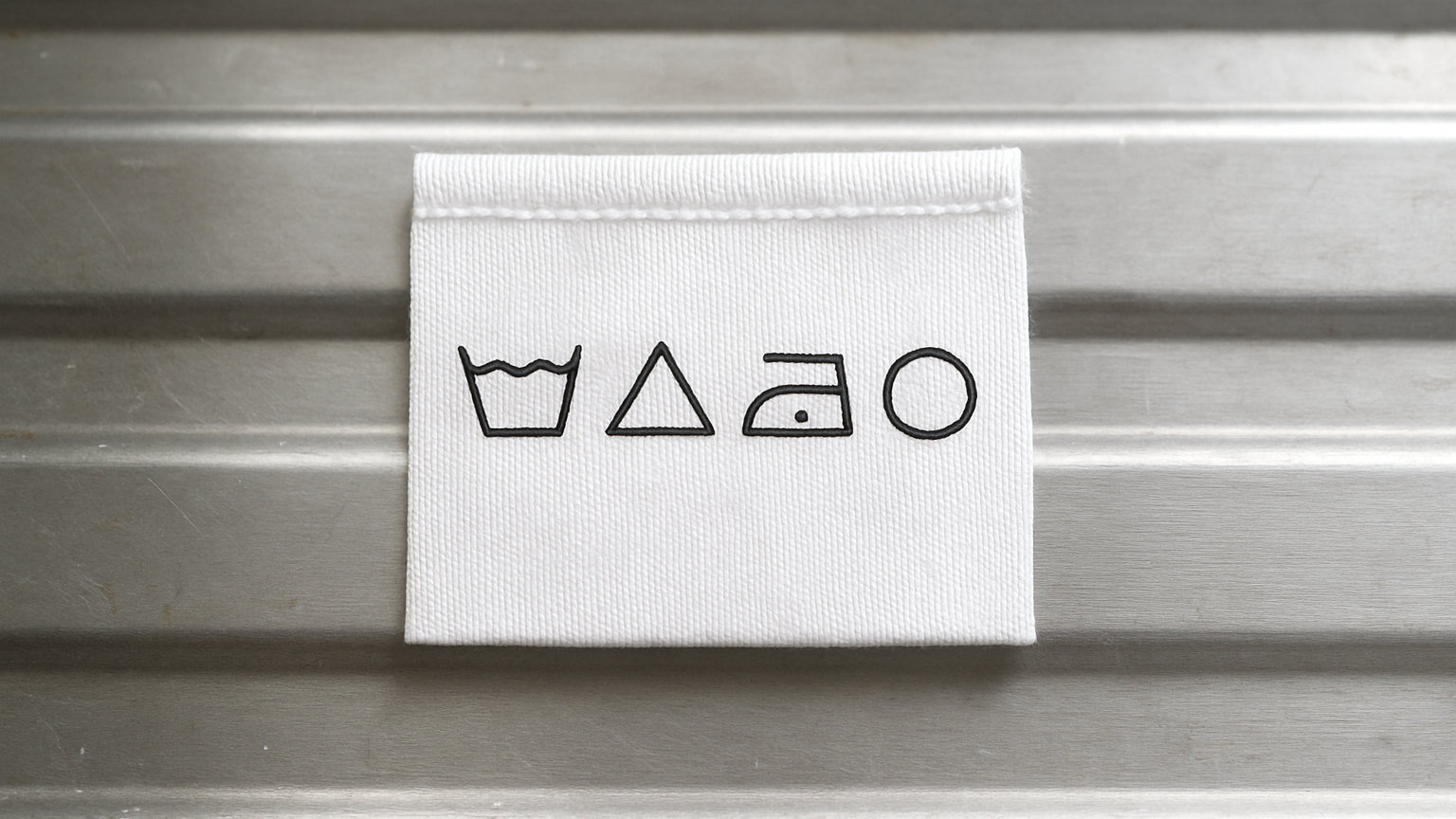
Care labels look cryptic and are actually quite systematic. There are five basic symbols, they always appear in the same order, and each one refers to a different stage of cleaning. Learn the five shapes and the rest falls into place, because everything else is a variation added to one of them.
What are the five symbols?
- A tub of water – washing.
- A triangle – bleaching.
- A square – drying.
- An iron – ironing.
- A circle – professional cleaning, meaning dry cleaning or wet cleaning.
They appear left to right in that order, which follows the sequence you would actually do them in. If a garment only has three symbols, the manufacturer has chosen to include only those three, and the omitted stages are usually implied rather than forbidden.
What do the modifiers mean?
Three modifications are used across all five symbols and mean the same thing in each case.
A cross through a symbol means do not do it at all. A crossed out iron means do not iron; a crossed out tub means do not wash.
Dots inside a symbol indicate temperature. One dot is coolest, two is medium, three is hot. This applies to both the iron and the tumble dryer square.
Bars underneath a symbol indicate reduced mechanical action. One bar means a gentle or permanent press cycle; two bars mean a very gentle or delicate cycle. No bar means normal.
Where is the label?
Usually in the side seam a few inches above the hem, or at the back of the neck. On trousers it is often in the waistband or in a pocket bag. On bedding it is at a corner of a fitted sheet or along a seam of a duvet cover.
On some garments the information is printed directly onto the fabric inside the neckline rather than on a sewn-in tag, which is increasingly common and wears off over time.
What order should you read it in?
- Check the crossed out symbols first. These are absolute limits and tell you what not to do.
- Check the wash symbol for temperature and for bars indicating a gentle cycle.
- Check the dry symbol, since tumble drying is where most damage happens.
- Check the iron symbol for the maximum temperature.
- Read the fibre content, which is often on a separate label and tells you more than the symbols do.
Why does the fibre content matter as much as the symbols?
Because it explains the symbols and lets you make sensible judgements the symbols cannot cover. A label saying 95 per cent cotton and 5 per cent elastane tells you why the wash symbol says 30 rather than 40, and it tells you not to tumble dry even if the label permits it.
It is also the information you need when a garment has no care symbols at all.
Are the symbols the same everywhere?
Broadly in the UK and Europe, where the same system is used. North America uses a similar set with some differences, most noticeably that the wash tub often shows dots rather than a temperature in degrees. Japan uses a related but distinct system.
Clothing sold internationally often carries more than one set, which is why some labels are considerably longer than they need to be.
What if the symbols and the written instructions disagree?
Follow the more cautious of the two. A discrepancy usually means a labelling error, and there is no way to know which one is right. Treating the garment more carefully costs nothing beyond a slightly longer cycle.
Should you keep the label?
Photograph it if you intend to cut it out, or note the details somewhere. The single most common reason people guess at how to wash something is that the label was removed because it scratched, and the information went with it.
What is not on the label?
Several things that matter. Whether the garment is colour fast, whether it will shrink on the first wash, whether it should be washed with other items, and which side to iron. The symbols describe what the fabric tolerates, not how it behaves alongside everything else in the drum, which is why a new deep red shirt marked 40 still needs washing separately the first few times.